
How much caffeine is in a latte? It depends on the espresso shots, not the cup. A one-shot latte has about 63 mg of caffeine and a two-shot latte about 126 mg, based on USDA espresso data. Milk adds none. At Starbucks, a Tall latte lists 75 mg and a Grande 150 mg.
So the fastest way to know your latte’s caffeine is to count the shots: a 20 oz latte with two shots has no more caffeine than a 12 oz latte with two. For per-shot detail, including Starbucks and capsule shots, see our guide to caffeine in a shot of espresso.
The short answer
| Latte | Espresso inside | Caffeine |
|---|---|---|
| Single-shot latte | 1 shot (about 1 oz) | about 63 mg |
| Double-shot latte | 2 shots (about 2 oz) | about 126 mg |
| Triple-shot latte | 3 shots | about 189 mg |
| USDA reference latte, 12 oz | about 2 oz espresso + 10 oz milk | about 130 mg |
| Starbucks Tall / Grande (hot) | 1 / 2 shots | 75 / 150 mg |
| Decaf latte | decaf shots | usually a few mg |
The shot figures scale USDA’s average of 212 mg of caffeine per 100 g of espresso. Real café shots can land well above or below that average.
Do lattes have caffeine?
Yes. A regular latte always contains caffeine because it is made with espresso, which is coffee. The steamed milk dilutes the taste but not the caffeine, so every milligram in the cup comes from the shots.
That is why a latte can taste mild and still wake you up. A creamy 16 oz latte with two shots carries the same caffeine as a straight double espresso. Only a latte made with decaf espresso is close to caffeine-free, and even that is not zero (see below).
Does a latte have espresso or coffee in it?
A latte is espresso plus steamed milk, topped with a thin layer of foam. So yes, it has espresso, and yes, that means it has coffee: espresso is simply coffee brewed under pressure into a small, concentrated shot. USDA’s standard recipe for a latte is exactly that, espresso and 2% milk, with nothing else.
Some cafés make “latte-style” drinks from strong brewed coffee, but that is a workaround, not a classic latte. The same goes for tea drinks: a chai latte or matcha latte uses “latte” to mean “with steamed milk” and contains no espresso unless you ask for a shot. Our types of espresso drinks guide shows how the latte fits among the other milk drinks.
How many espresso shots are in a latte?
Usually one or two. Many cafés build small lattes on a single shot and larger ones on a double. Starbucks’ own recipes use one shot in a Short (8 oz) and Tall (12 oz) hot latte, and two shots in a Grande (16 oz) and Venti (20 oz). At home, a double shot is the common starting point for a 10–12 oz cup. If you want the full breakdown of milk and shots by cup size, see our latte milk ratio guide.
How much caffeine in a latte by cup size
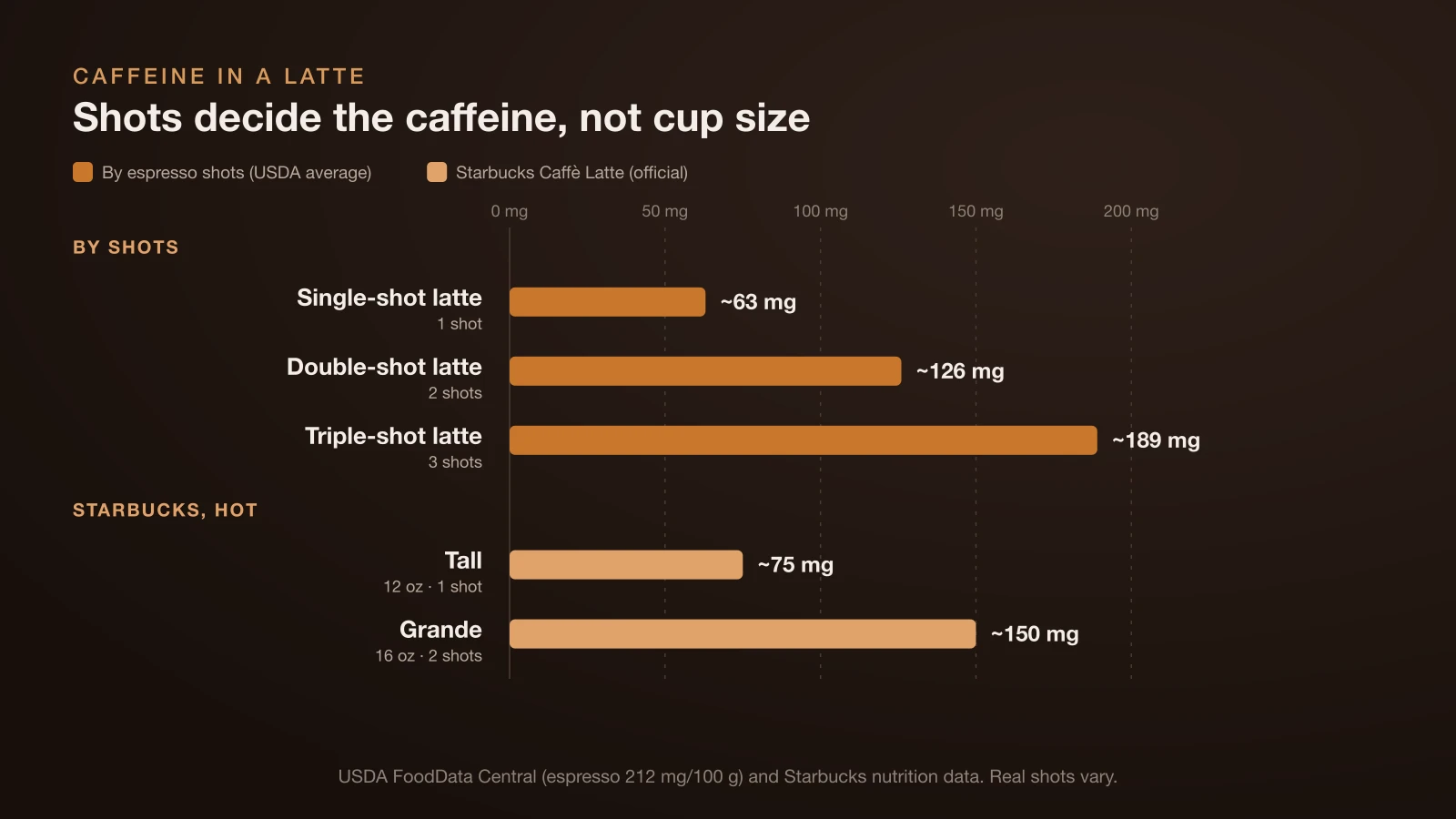
There is no official latte size, so the honest answer uses two views: the shot count, and USDA’s reference latte.
By shot count. At about 63 mg per average shot, the caffeine in a latte is simply 63 mg times the number of shots. An 8 oz and a 16 oz latte with the same two shots both have about 126 mg.
USDA’s reference latte. USDA FoodData Central lists a standard latte at 36 mg of caffeine per 100 g, based on a recipe of about 62 g of espresso and 305 g of 2% milk. That is roughly 2 oz of espresso to 10 oz of milk. USDA scales this same recipe to its portion sizes, which gives these estimates:
| USDA portion | Weight | Caffeine (estimate) |
|---|---|---|
| 1 cup (8 fl oz) | 240 g | about 86 mg |
| Small (about 12 oz) | 360 g | about 130 mg |
| Medium (about 16 oz) | 480 g | about 173 mg |
| Large (about 20 oz) | 600 g | about 216 mg |
The catch: USDA’s model keeps the espresso share fixed, so bigger cups get more espresso. Many cafés instead keep the shot count the same across sizes, so a large café latte can have less caffeine than the USDA large. Use the shot count whenever you know it.
Starbucks latte caffeine by size
Starbucks publishes caffeine for each size of its Caffè Latte. These are the figures on its official menu, made with its standard Signature Espresso and 2% milk:
| Size | Hot latte | Iced latte |
|---|---|---|
| Short (8 oz) | 1 shot, 75 mg | not offered |
| Tall (12 oz) | 1 shot, 75 mg | 1 shot, 75 mg |
| Grande (16 oz) | 2 shots, 150 mg | 2 shots, 150 mg |
| Venti | 20 oz: 2 shots, 150 mg | 24 oz: 3 shots, 225 mg |
Two details stand out. A hot Venti has no more caffeine than a Grande, because both use two shots. And Starbucks counts about 75 mg per shot, a little above USDA’s 63 mg average, which is normal for a chain with its own dose and shot size. These are Starbucks’ published figures as of October 2026.
Starbucks’ espresso options change the total. Its lighter Blonde Espresso carries a little more caffeine: the one-shot Tall Blonde Vanilla Latte lists 85 mg and the two-shot Grande 170 mg, against 75 mg and 150 mg for the Caffè Latte. The menu also offers 1/3, 1/2 and 2/3 decaf shots, which lower the caffeine without changing the size or the milk.
Caffeine in chai, matcha, mocha and other lattes
Not every drink called a latte gets its caffeine from espresso. Tea lattes use tea instead, and chocolate adds a little caffeine of its own. Starbucks’ Grande (16 oz) figures, as of October 2026, show the spread:
| Starbucks Grande | Caffeine source | Caffeine |
|---|---|---|
| Caffè Latte | 2 espresso shots | 150 mg |
| Pumpkin Spice Latte | 2 espresso shots | 150 mg |
| Blonde Vanilla Latte | 2 Blonde Espresso shots | 170 mg |
| Caffè Mocha | 2 espresso shots + mocha sauce | 175 mg |
| Matcha Latte | Green tea powder | 65 mg |
| Chai Latte | Black tea concentrate | 55 mg |
| London Fog Latte | Earl Grey tea | 40 mg |
Syrups and sauces without cocoa add nothing, which is why the Pumpkin Spice Latte matches the plain latte. The mocha’s extra 25 mg, by simple subtraction, comes from its chocolate sauce; our mocha vs latte comparison covers the rest of the difference.
Tea lattes behave differently with size. The Chai Latte rises from 25 mg in a Short to 75 mg in a Venti, because bigger cups get more concentrate, while the London Fog lists 40 mg in every size. A dirty chai latte adds one or two espresso shots to chai, so its caffeine is the tea’s plus roughly 63 mg per average shot.
Iced latte caffeine
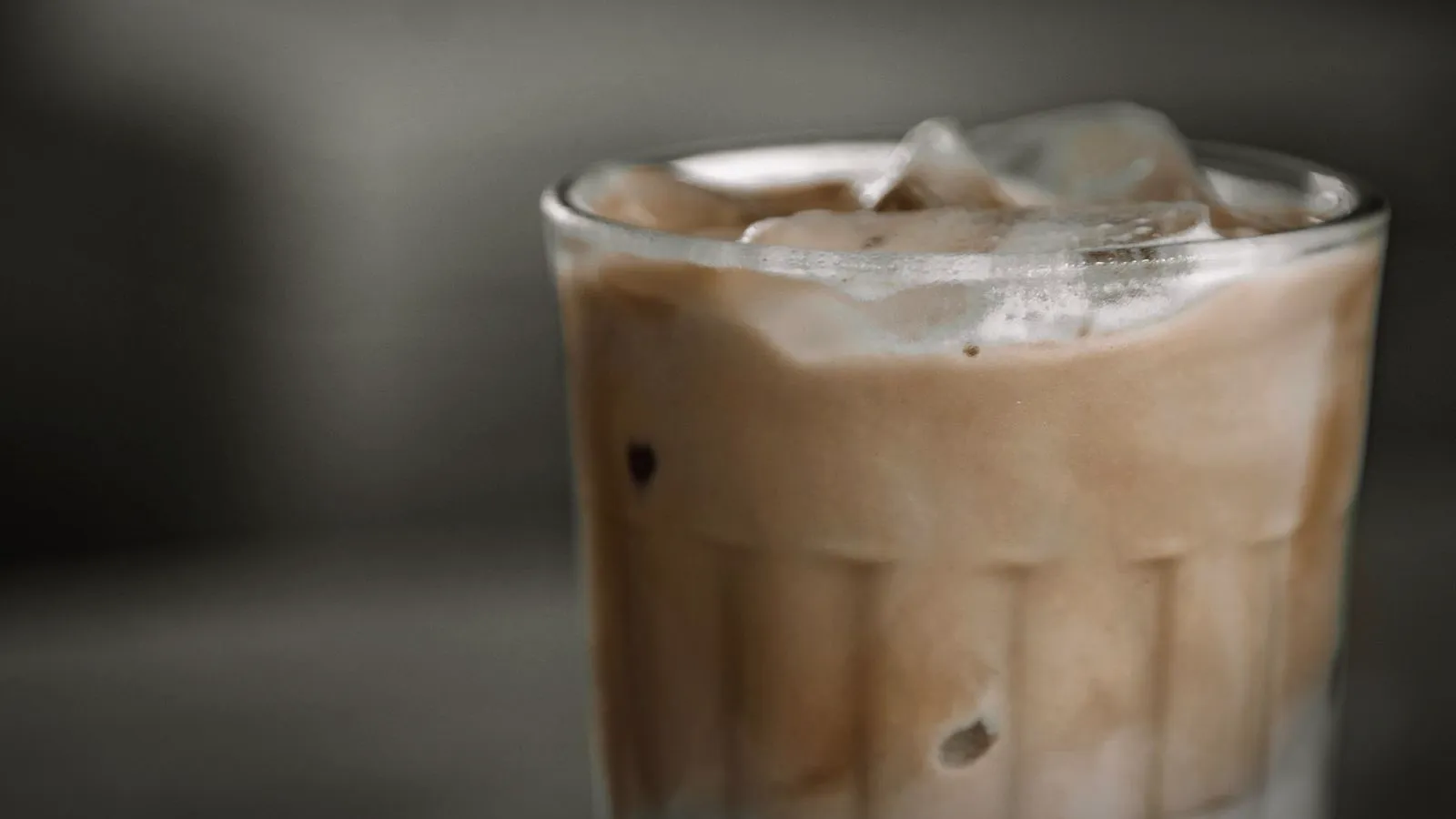
An iced latte has the same caffeine as a hot latte with the same number of shots. Ice and cold milk add none. USDA’s iced latte entry lists 37 mg per 100 g, almost identical to the hot version, from the same 62 g of espresso with less milk and a cup of ice.
Where iced lattes differ is portion size. Iced cups are often larger, and some chains add a shot to the biggest size, as Starbucks does with its 24 oz iced Venti (three shots, 225 mg). As the ice melts, the drink gets weaker in taste, but the caffeine stays the same.
Decaf latte caffeine
A decaf latte is low in caffeine but not caffeine-free. USDA lists its decaf latte at 0 mg per 100 g, a rounded laboratory figure. Real café decaf shots measured in a 2006 study ranged from 3 to 15.8 mg each, so a two-shot decaf latte could hold roughly 6–32 mg.
That is still a large cut from about 126 mg for a regular double. Our guide to caffeine in decaf espresso explains why decaf varies and what the label legally means. A “half-caf” latte, with one regular and one decaf shot, lands in between.
Why your latte’s caffeine can be higher or lower
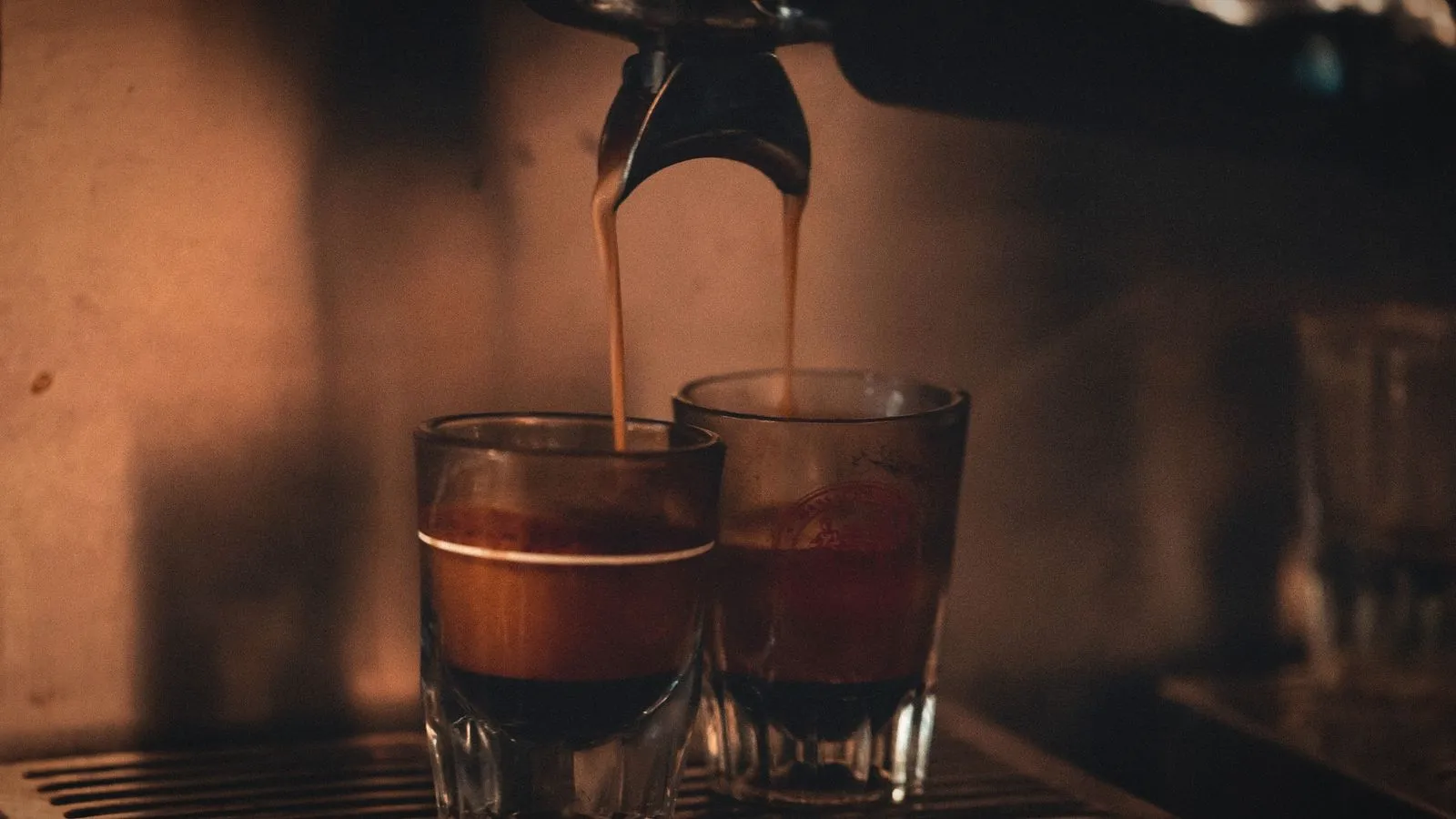
A latte’s caffeine depends on how much coffee goes into each shot, which beans are used and how big the café’s shots are, so averages hide a wide spread. In a 2014 study of 104 café espressos from Scotland, Italy and Spain, caffeine ranged from 48 to 317 mg per serving. A 2012 study of 20 commercial espressos found a six-fold difference between the weakest and strongest.
The main reasons:
- Dose. More ground coffee per shot means more caffeine. The 2012 researchers pointed to the amount of coffee used as the likely main cause.
- Bean species. Robusta beans contain much more caffeine than arabica, so a robusta blend raises the number. Our guide to espresso beans covers blends.
- The café’s definition of a shot. Some pull small, tight singles; others pour bigger, heavier-dosed shots.
What doesn’t matter: the milk type. Whole, skim, oat or almond milk changes calories and taste, not caffeine.
Homemade lattes often land above the USDA figure for this reason. A 2023 Technical University of Munich study measured about 183 mg in a 40 g espresso pulled from 20 g of arabica, a common home double. A latte built on that shot carries about 183 mg too, whatever the cup size.
How to get more or less caffeine in a latte
You can change a latte’s caffeine without changing its size or milk, simply by changing the espresso. These are the usual levers:
| Change | Effect on caffeine |
|---|---|
| Add a shot | about +63 mg on average, +75 mg at Starbucks |
| Bigger dose at home (20 g double) | about 183 mg per double instead of about 126 mg |
| Blonde Espresso at Starbucks | about +10 mg per shot |
| Ristretto shots | less: about 65 mg per Starbucks ristretto shot |
| Half-caf (half the shots decaf) | roughly half, plus a few mg from the decaf |
| Single shot instead of a double | about 63 mg instead of 126 mg |
| Decaf | usually a few mg per shot |
The Starbucks ristretto figure is an estimate, from its two-shot Tall Flat White at 130 mg. Asking for a smaller cup does nothing unless the café also uses fewer shots, so ask about the shot count rather than the size.
Does a latte have more caffeine than drip coffee?
Drip coffee usually has more caffeine than a latte, serving for serving. USDA data puts an 8 oz cup of brewed coffee at about 95 mg, compared with about 63 mg for a single-shot latte of any size. A double-shot latte (about 126 mg) overtakes an 8 oz cup, but large brewed coffees climb fast: Starbucks lists 315 mg for a Grande Pike Place Roast versus 150 mg for a Grande latte.
So a latte tastes smoother and often has less caffeine than the same size of regular coffee. We compare the two drinks in full, including calories and taste, in latte vs coffee. If you want both in one cup, a red eye adds a shot to brewed coffee; see our guide to coffee with a shot of espresso.
How much caffeine is too much?
The FDA says 400 mg a day is an amount not generally associated with negative effects for healthy adults. That is about six single-shot lattes or three double-shot lattes at average strength, with no other caffeine that day.
Because café lattes can contain more than the average, the same number of drinks can add up faster. The FDA advises people who are pregnant, trying to become pregnant or breastfeeding to talk with a healthcare provider about caffeine. This is general information, not medical advice.
The bottom line
A latte’s caffeine comes from its espresso: about 63 mg per average shot, so most lattes land between 63 and 150 mg, and a home latte on a 20 g double can reach about 183 mg. Cup size and milk don’t change it unless the size adds a shot, while chai, matcha and London Fog lattes run lower because they use tea. To know what you are drinking, ask how many shots are in the cup, or check the chain’s nutrition page.
Sources
- USDA FoodData Central: Coffee, Latte (36 mg caffeine per 100 g; recipe and portion weights), Coffee, Iced Latte (37 mg per 100 g) and Coffee, brewed, espresso, restaurant-prepared (212 mg per 100 g)
- Starbucks nutrition, as of October 2026 (caffeine and shots by size): Caffè Latte, Iced Caffè Latte, Blonde Vanilla Latte, Caffè Mocha, Pumpkin Spice Latte, Matcha Latte, Chai Latte, London Fog Latte, Cappuccino and Flat White
- Peer-reviewed studies: Food & Function, Crozier et al. (2012) and Ludwig et al. (2014) (caffeine variation in café espresso); Foods, Schmieder et al. (2023) (182.6 mg from a 20 g arabica dose at 1:2); Journal of Analytical Toxicology, McCusker et al. (2006) (caffeine in decaf espresso)
- U.S. Food and Drug Administration: Spilling the Beans: How Much Caffeine Is Too Much?