

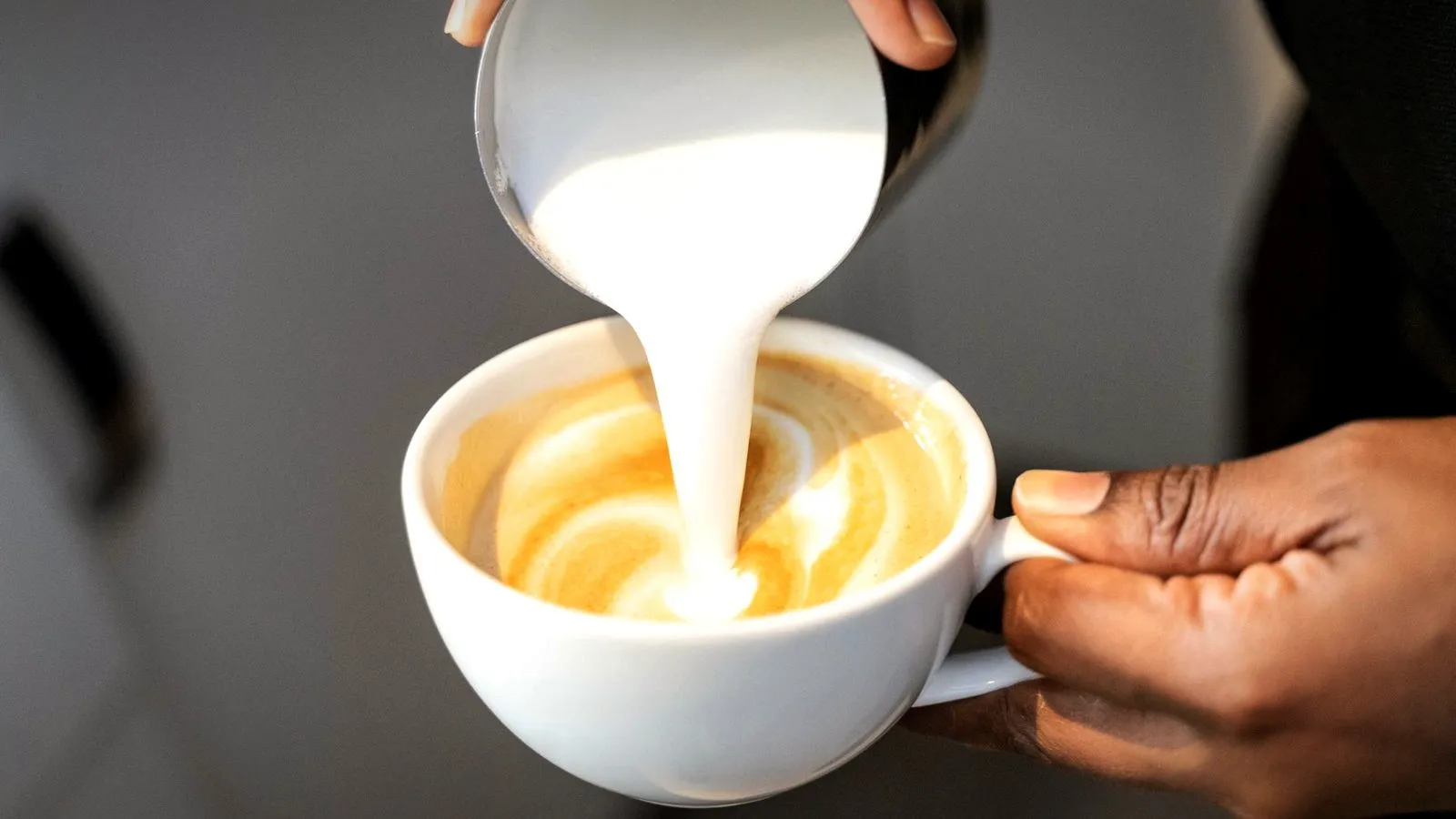
How much milk goes in a latte? Most lattes use about 5 to 10 oz (150–300 ml) of steamed milk with one or two shots of espresso. That is a ratio of roughly 1 part espresso to 3–5 parts milk, topped with a thin layer of foam about 1 cm deep. These are café conventions, not fixed rules, so sizes vary.
Cup size is the biggest variable. The espresso usually stays at one or two shots while the milk grows to fill the cup, so a 16 oz latte can be twice as milky as an 8 oz one. For the full step-by-step method, from pulling the shot to steaming and pouring, see how to make a latte.
The short answer
| Cup size | Espresso | Steamed milk | Ratio (espresso : milk) |
|---|---|---|---|
| 8 oz (240 ml) | 1–2 shots, 1–2 oz (30–60 ml) | 5–6 oz (150–180 ml) | about 1:2.5 to 1:6 |
| 10 oz (300 ml) | 2 shots, 2 oz (60 ml) | about 7 oz (210 ml) | about 1:3.5 |
| 12 oz (350 ml) | 2 shots, 2 oz (60 ml) | 8–9 oz (240–270 ml) | about 1:4 to 1:4.5 |
| 16 oz (475 ml) | 2–3 shots, 2–3 oz (60–90 ml) | 12–13 oz (350–385 ml) | about 1:4 to 1:6 |
| 20 oz (590 ml) | 2–3 shots, 2–3 oz (60–90 ml) | 16–17 oz (475–500 ml) | about 1:5.5 to 1:8.5 |
These are typical ranges, not a standard. Milk amounts are measured as steamed milk in the cup and leave a little room at the rim.
What is the latte ratio?
The latte ratio is the proportion of espresso to milk. There is no official definition, but most cafés and recipes land between 1:3 and 1:5, meaning three to five times as much milk as espresso. A 1:3 latte tastes noticeably of coffee; a 1:5 latte is milder, sweeter and creamier. This is not the same as the espresso brew ratio of coffee dose to shot weight, which our espresso ratio guide explains.
Three published reference points show where that range comes from:
- USDA’s standard latte is built from about 62 g of espresso and 305 g of 2% milk, roughly 1:5 by weight, or about 2 oz of espresso to 10 oz of milk.
- Breville’s machine manual describes a latte as a single espresso with textured milk and about 10 mm of foam, in a 200–220 ml glass. With a 30 ml shot, that leaves about 170–190 ml for milk and foam, an estimate of roughly 1:6.
- Starbucks uses one shot in its 8 oz and 12 oz hot lattes and two in its 16 oz and 20 oz, so its milk share is on the high side.
Cafés that serve “specialty” lattes often go stronger, with a double shot in a 10–12 oz cup.
Latte milk to espresso ratio by volume or weight
Ratios are usually quoted by volume in ounces or milliliters. Milk and espresso are both close to water in density, so a volume ratio and a weight ratio come out nearly the same. If you use a scale, 60 g of espresso to 240 g of milk is the same drink as 2 oz to 8 oz, give or take a few percent.
How much milk in a latte by cup size
An 8 oz latte takes about 5–6 oz of milk, a 10–12 oz latte about 7–9 oz and a 16 oz latte about 12–13 oz, depending on the number of shots. Here is how those amounts play out in practice.
- 8 oz (240 ml). The most coffee-forward latte. With a single shot, use about 5–6 oz of milk. With a double, stay near 5 oz or the drink will overflow.
- 10–12 oz (300–350 ml). The classic home latte. A 2 oz double with 7–9 oz of steamed milk lands right in the 1:3.5 to 1:4.5 range.
- 16 oz (475 ml). With two shots, you need about 12–13 oz of milk to fill the cup, a ratio near 1:6. A third shot brings it back toward 1:4.
- 20 oz (590 ml). Mostly milk. Even with three shots the ratio is about 1:5.5, so expect a very mild drink.
A bigger cup does not mean more coffee unless you add shots. It mainly means more milk, so the drink gets milder and higher in calories while the caffeine stays with the shots.
How much milk in a latte with one shot vs two shots
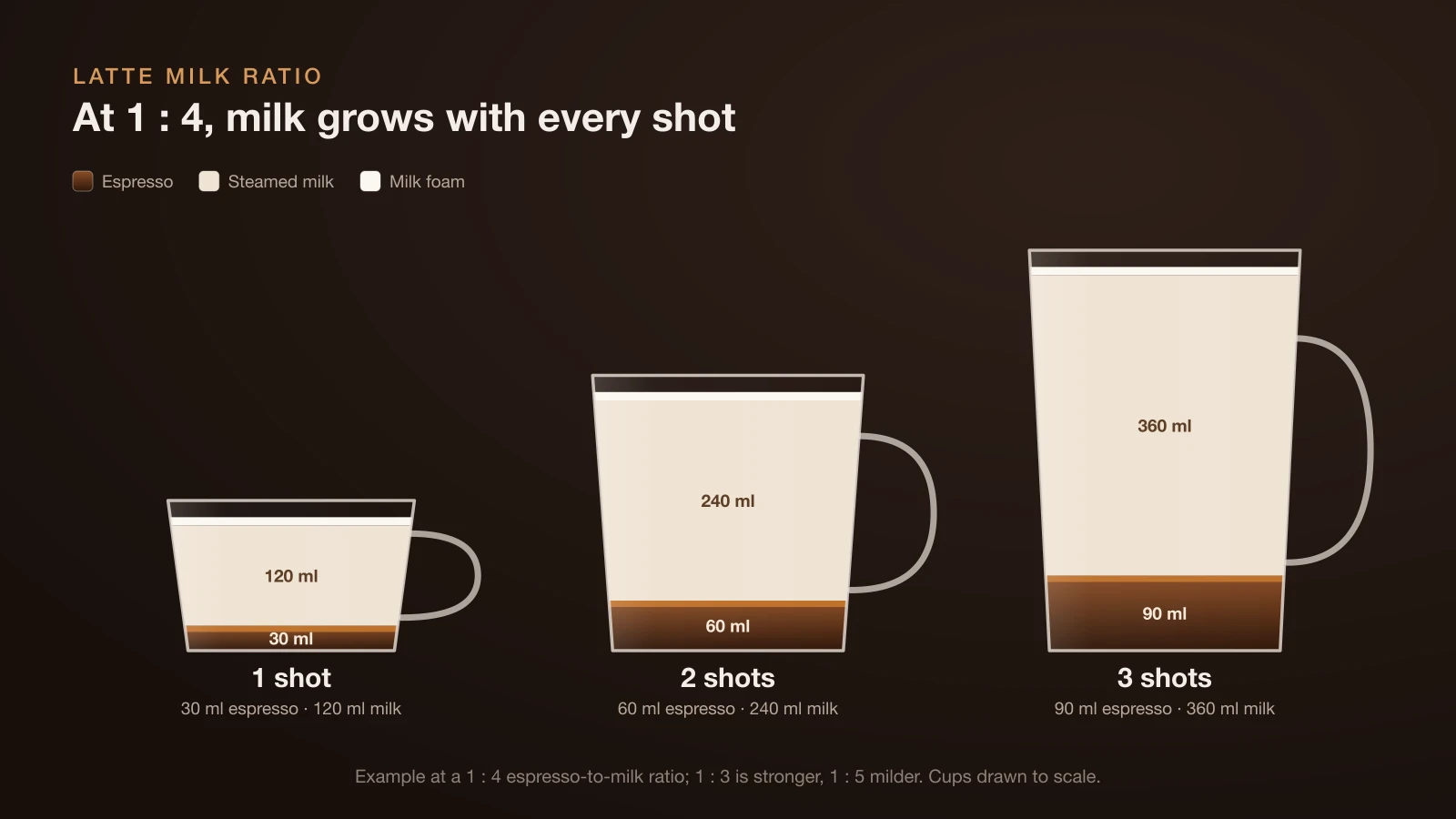
If you start from the shot rather than the cup, multiply the espresso volume by your chosen ratio:
| Espresso | Milk at 1:3 | Milk at 1:4 | Milk at 1:5 |
|---|---|---|---|
| 1 shot, 1 oz (30 ml) | 3 oz (90 ml) | 4 oz (120 ml) | 5 oz (150 ml) |
| 2 shots, 2 oz (60 ml) | 6 oz (180 ml) | 8 oz (240 ml) | 10 oz (300 ml) |
| 3 shots, 3 oz (90 ml) | 9 oz (270 ml) | 12 oz (360 ml) | 15 oz (450 ml) |
A single shot with 4–5 oz of milk fits a 6–8 oz cup. A double with 8–10 oz of milk is the 12 oz latte most cafés sell. Shot volumes vary: Italy’s espresso institute defines an espresso as about 25 ml, and many home machines pull about 30 ml per single.
How many shots of espresso in a latte?
One or two is standard. Small lattes (8 oz and under) often use one shot; 12 oz and larger usually use two. Some cafés and home baristas use a double as the default for every size. If a large latte tastes like warm milk, the fix is a third shot rather than less milk.
How much milk to pour into the pitcher
Pour slightly less cold milk than the cup needs, because steaming adds a little volume as air goes in: about 4–5 oz for an 8 oz latte and 7–8 oz for a 12 oz latte. Breville’s own latte recipe starts from about half a cup (4 oz) of milk, and its manual says never to fill the jug above the bottom of the “V” in the spout.
| Making | Cold milk to start | Pitcher size |
|---|---|---|
| One 8 oz latte | about 4–5 oz (120–150 ml) | 12 oz |
| One 12 oz latte | about 7–8 oz (210–240 ml) | 12–20 oz |
| One 16 oz latte | about 11–12 oz (325–350 ml) | 20 oz |
| Two 12 oz lattes | about 14–16 oz (415–475 ml) | 32 oz |
These amounts follow from the cup-size table above and are starting points, not a standard. A pitcher that is too small for the milk overflows once the foam builds, while a little leftover milk in the pitcher is normal and easy to avoid next time.
Measuring milk without a scale
Most steaming pitchers have no volume marks, so measure once with a measuring cup and note how high the milk sits in your pitcher, often just below where the spout begins. After that, pour to the same level each time. A scale works too: milk weighs about 30.5 g per fluid ounce, so 8 oz of milk is roughly 245 g.
How much milk in an iced latte?

An iced latte uses less milk than a hot one of the same cup size, because ice takes up part of the glass. USDA’s iced latte recipe uses about 62 g of espresso, 183 g of 2% milk and one cup of ice. That is roughly 2 oz of espresso to 6 oz of milk, a ratio near 1:3.
In a 12 oz glass, that translates to a double shot, about 6 oz of cold milk and ice to the top. In a 16 oz glass, use about 8 oz of milk. Starbucks keeps its iced Tall at one shot and iced Grande at two, then adds a third shot to its 24 oz iced Venti.
Latte milk ratio with a capsule machine, moka pot or brewed coffee
The weaker the coffee base, the less milk it can carry before it tastes like warm milk, so pod, moka and brewed-coffee lattes use lower ratios than an espresso latte.
| Coffee base | Coffee | Milk | Ratio (approx.) |
|---|---|---|---|
| Espresso, double shot | 2 oz (60 ml) | 6–10 oz | 1:3 to 1:5 |
| Nespresso lungo capsule | 110 ml (about 3.7 oz) | 220 ml (7.4 oz) | 1:2 |
| Moka pot coffee | 2–3 oz | 6–8 oz | about 1:2 to 1:4 |
| Strong brewed coffee | 4–6 oz | 4–6 oz | about 1:1 |
The Nespresso row is the company’s own Caffè Latte recipe, served in a 12 oz (350 ml) glass. A lungo is a longer, more diluted extraction than an espresso, so it is paired with only twice its volume of milk. The moka and brewed-coffee rows match the methods in our latte at home guide: brew drip coffee about twice as strong as usual so equal parts milk does not drown it.
How much foam on a latte?

A latte has the thinnest foam of the classic milk drinks. Breville’s manual specifies about 10 mm (just under half an inch) of foam on a latte. That thin layer is why a latte feels smooth and liquid all the way down.
Foam depth is part of the milk ratio. The more air you add while steaming, the more of the cup is foam instead of liquid milk, and the drink starts to drift toward a cappuccino. For a latte, add air for only a few seconds, then let the milk spin until it looks glossy. Our espresso with milk guide explains steaming temperature and foam texture.
Latte ratio vs cappuccino, flat white and cortado
A latte is the milkiest of the four, while a cappuccino turns more of its milk into foam, a flat white uses less milk in a smaller cup and a cortado is close to equal parts espresso and milk.
| Drink | Typical espresso | Typical milk | Ratio (approx.) | Foam |
|---|---|---|---|---|
| Latte | 1–2 shots | 5–10 oz (150–300 ml) | 1:3 to 1:5 | Thin, about 1 cm |
| Cappuccino | 1 shot, 25 ml (IEI) | 100 ml steamed milk (IEI) | about 1:4, with more of it foam | Thick |
| Flat white | 1 or 2 shots | Less than a latte, cup of 8 oz or less | Varies with the cup; stronger than a latte | Thin, about 1/4 in (6 mm) |
| Cortado | 2 shots | About equal milk | about 1:1 to 1:2 | Little or none |
The cappuccino row is the Istituto Espresso Italiano’s certified recipe and the flat white row follows Breville’s guideline; the latte and cortado rows are common conventions. The key difference is not just how much milk, but how much of it is foam. Read flat white vs cappuccino and cortado vs latte for the full comparisons.
How the amount of milk changes calories and caffeine
More milk adds calories but not caffeine. Every extra fluid ounce of whole milk adds about 19 kcal, 2% milk about 15 kcal and skim about 10 kcal, based on USDA values per 100 g. Espresso adds almost nothing, so the milk amount drives nearly all of a plain latte’s calories.
| Milk in the cup | Whole milk | 2% milk | Skim milk |
|---|---|---|---|
| 4 oz | about 75 kcal | about 60 kcal | about 40 kcal |
| 8 oz | about 150 kcal | about 120 kcal | about 85 kcal |
| 12 oz | about 225 kcal | about 185 kcal | about 125 kcal |
Caffeine works the other way: it comes only from the shots, so a double in a 16 oz latte has the same caffeine as a double in an 8 oz one. Our guides to latte calories and latte caffeine give the full numbers by milk type and size.
How to adjust the latte ratio to taste
To adjust a latte, start at about 1:4 espresso to milk, then add a shot or use a smaller cup if it tastes too milky, and add milk if it tastes too strong.
- Start at 1:4. A 2 oz double with 8 oz of steamed milk in a 10–12 oz cup is a sensible baseline.
- Too milky? Add a shot or drop to a smaller cup before cutting milk sharply.
- Too strong or bitter? Move toward 1:5, or switch to whole milk, which tastes sweeter and rounder.
- Adding syrup? Flavor syrups take space and sweetness, so a slightly stronger ratio keeps the coffee noticeable.
- Steam a little less than you need. Start with slightly less cold milk than the target, since steaming adds some volume.
The bottom line
A latte is mostly milk: about 5–10 oz of steamed milk to one or two shots, a ratio of roughly 1:3 to 1:5, under about 1 cm of foam. For a 12 oz cup, a double shot and 8–9 oz of milk is the classic balance. Bigger cups need more shots, not just more milk, if you want the coffee to come through.
Sources
- USDA FoodData Central: Coffee, Latte (62 g espresso + 305 g 2% milk), Coffee, Iced Latte (62 g espresso + 183 g milk + 1 cup ice), Milk, whole (61 kcal per 100 g; 1 fl oz = 30.5 g), Milk, 2% (50 kcal per 100 g) and Milk, nonfat (34 kcal per 100 g)
- Breville: Barista Express BES875 instruction book (latte: single espresso, about 10 mm foam, 200–220 ml glass; fill the jug just below the “V” of the spout), How to make a latte (about half a cup of milk) and How to make a flat white at home (single or double shot, cup of 8 oz or less, microfoam about a quarter inch thick)
- Istituto Espresso Italiano: Certified Italian Espresso and Cappuccino (25 ml espresso; cappuccino with 100 ml steamed milk)
- Starbucks: Caffè Latte and Iced Caffè Latte (espresso shots by size)
- Nespresso: Caffè Latte recipe (lungo of 110 ml, 220 ml of milk, 350 ml glass)