

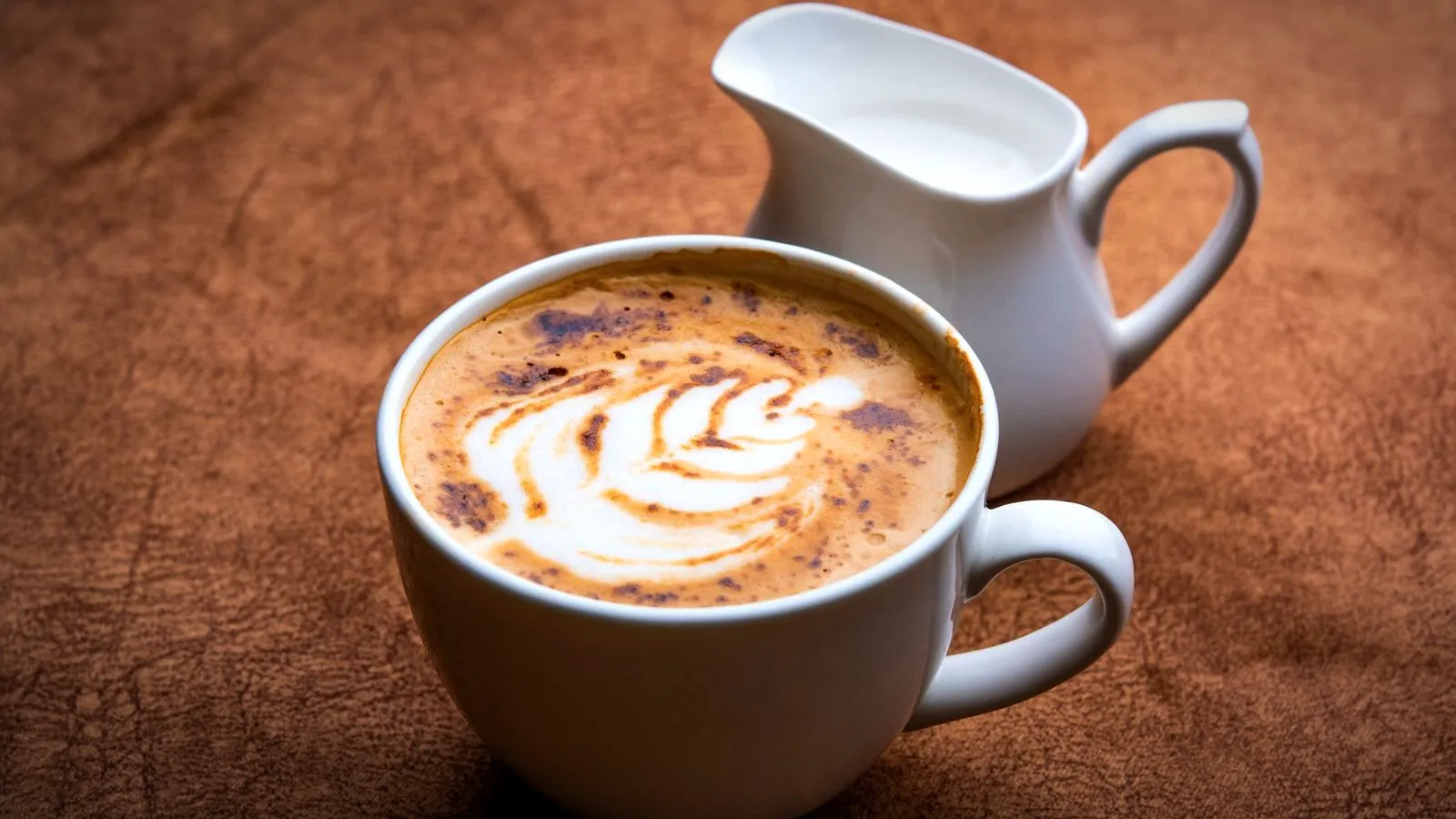
To make a latte at home, pull a double shot of espresso (about 2 oz) into a 10–12 oz cup, steam about 6–8 oz of milk to 60–65 °C (140–150 °F) with a thin layer of foam, then pour the milk into the espresso. No machine? Froth hot milk with a frother, French press or jar.
A latte is simply espresso plus a lot of steamed milk and a little foam, which makes it one of the easiest espresso drinks with milk to learn at home. The milk forgives a lot: a shot that would taste slightly sharp on its own is softened by 6–8 oz of sweet, warm milk. What it does not forgive is weak coffee, scalded milk or too much foam.
The short answer
| Step | What to do | Typical target |
|---|---|---|
| 1. Espresso | Pull a double shot | 18 g coffee → about 36 g (2 oz) espresso in 25–30 s |
| 2. Milk | Steam cold milk, add a little air first | 60–65 °C (140–150 °F), thin foam layer |
| 3. Cup | Use a warm cup | 8–12 oz (240–350 ml) |
| 4. Pour | Tilt the cup, pour milk into the center | Finish with about 1 cm of foam |
| Ratio | Espresso : milk | About 1:3 to 1:5 |
These are common café conventions, not fixed rules. Adjust the milk to taste.
What you need to make a latte at home
| Equipment | Needed? | Why |
|---|---|---|
| Espresso machine with steam wand | Best option | Makes real espresso and silky microfoam |
| Burr grinder or fresh espresso grind | Recommended | Espresso needs a fine, even grind |
| Milk pitcher (12–20 oz) | Recommended | Room for milk to expand while steaming |
| Thermometer | Optional | Helps you stop at the right temperature |
| Handheld frother, French press or jar | Alternative | Foams milk without a steam wand |
| Moka pot | Alternative | Strong coffee for a latte-style drink |
| Scale | Optional | Makes shots repeatable |
Any espresso machine works. Our guide to how to use an espresso machine covers setup, dialing in and purging if you are starting from scratch.
Which coffee to use for a latte
A medium, medium-dark or dark roast is the safest choice for a latte, because its chocolate and caramel notes stay noticeable under several ounces of milk. Breville makes the same recommendation and warns that a light roast can leave the coffee flavor almost imperceptible in a milk drink. Our guide to espresso roast levels explains how each level tastes.
- Freshness matters more than the label. Breville’s manual suggests beans with a “roasted on” date, used about 5–20 days after roasting.
- Grind just before brewing. Pre-ground coffee goes stale quickly and makes thin shots with little crema.
- Decaf and half-caf work fine. Use decaf espresso beans, or pull one regular and one decaf shot for a half-caf latte.
How to make a latte with an espresso machine
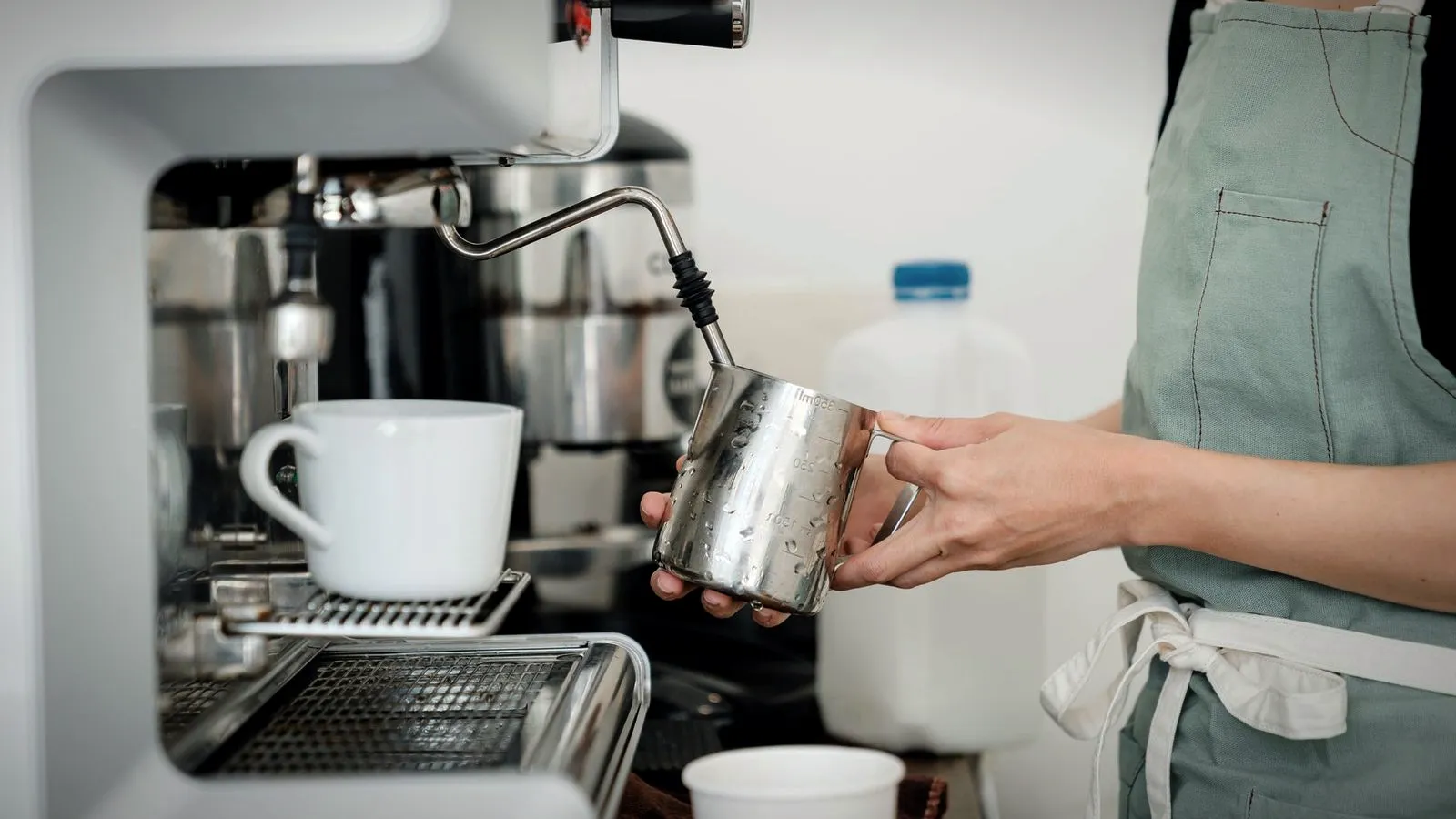
- Heat the machine and the cup. Let the machine warm up fully, and rinse your cup with hot water so the drink doesn’t cool on contact.
- Dose and grind. Grind about 16–20 g of fresh coffee fine, slightly finer than table salt, into a double basket.
- Tamp level. Distribute the grounds evenly, then tamp firmly and flat.
- Pull the shot. Aim for about twice the dose in liquid, for example 18 g in and 36 g out, in roughly 25–30 seconds. Brew straight into the latte cup.
- Fill the pitcher with cold milk. Pour about 6–8 oz of fresh, cold milk. Breville’s manual says to fill the jug no higher than just below the “V” at the bottom of the spout, which leaves room for the milk to expand.
- Purge the steam wand. Open it for a second to clear water.
- Stretch the milk. Put the tip about 1–2 cm (¼–¾ in) below the surface, near the side of the pitcher, and open the steam fully. Lower the pitcher slowly until you hear a soft tearing sound for a few seconds while air goes in. A latte needs only a little air.
- Texture and heat. Lower the tip slightly so the milk spins in a whirlpool. Stop at 60–65 °C (140–150 °F), when the pitcher is just too hot to hold comfortably.
- Tap and swirl. Tap the pitcher on the counter to pop large bubbles and swirl until the milk looks glossy, like wet paint.
- Pour. Pour the milk into the espresso straight away, using the two-stage technique below.
Wipe and purge the wand straight away so milk doesn’t dry inside it.
How to pour a latte
Pour a latte in two stages: first high and slow to mix the milk under the crema, then low and a little faster to let the foam rise to the top.
- Hold the cup tilted toward the pitcher so the espresso pools on one side.
- Pour a thin stream from a few inches up into the center. The milk dives under the crema and blends with the espresso instead of sitting on top.
- When the cup is about half full, bring the spout almost down to the surface and level the cup as it fills. The foam now spreads across the top; this is the stage where latte art starts.
- Stop just below the rim and serve right away.
Breville’s manual stresses working quickly, before the steamed milk starts to separate into liquid and foam. If you have to wait, swirl the pitcher again just before pouring.
Making two lattes at once
To make two lattes, pull both shots first, then steam enough milk for both drinks in one larger pitcher (about 20 oz for two 12 oz lattes). Swirl, pour half into the first cup, swirl again and pour the rest into the second. Swirling between pours keeps the foam evenly mixed, so the second latte is not left with all the thick foam from the top of the pitcher.
The right milk temperature for a latte
Aim for 60–65 °C (140–150 °F): hot enough to drink right away, with smooth foam. Much hotter and the foam coarsens and the milk tastes cooked. For wand position and the stretching phase in more detail, see steaming milk with a wand.
How to make a latte at home without an espresso machine
Without a machine you can still foam milk well. What you can’t make is true espresso, so pair these with the strongest coffee you can brew (next section). For each method, start by heating the milk to about 60–65 °C on the stove or in the microwave, without boiling.
| Method | How it works | Foam quality |
|---|---|---|
| Handheld frother | Whisk hot milk for 20–30 seconds, tip just below the surface | Good, slightly bubbly |
| French press | Pump the plunger up and down 15–20 times in hot milk | Good, fine foam |
| Lidded jar | Shake cold milk hard for 30–60 seconds, then microwave uncovered for about 30 seconds | Fair, light foam |
| Microwave + whisk | Heat milk, then whisk fast by hand | Basic |
Frother or French press
- Heat 6–8 oz of milk until hot but not boiling.
- Froth: hold a handheld frother just under the surface, or pump a French press plunger 15–20 times, until the milk roughly doubles in volume at the top.
- Let it rest 30 seconds so large bubbles rise, then tap and swirl.
- Pour the milk over your coffee, holding back the foam with a spoon, then spoon the foam on top.
Jar method
Fill a heat-safe jar no more than halfway with cold milk, screw the lid on tight and shake hard for 30–60 seconds. Remove the lid and microwave for about 30 seconds so the foam rises and sets. Shaking before heating avoids pressure building inside a hot, sealed jar.
Making a latte-style drink with a moka pot or brewed coffee
A moka pot makes strong, concentrated coffee, though at much lower pressure than an espresso machine, so it isn’t technically espresso. It still makes the most convincing latte-style drink without a machine. Our guide on how to use a moka pot explains the brewing steps.
- Moka pot: use about 2–3 oz of moka coffee with 6–8 oz of foamed milk.
- Drip, pour-over or French press coffee: brew it about twice as strong as usual and use roughly equal parts coffee and milk. Regular-strength coffee gets lost under a full latte’s worth of milk.
- Instant espresso powder: DeLallo, a maker of instant espresso powder, suggests 1 tablespoon of powder in 4 tablespoons (2 oz, 60 ml) of hot water as a quick stand-in.
These are honest workarounds, not a café latte. The flavor is thinner and there is no crema, but with good foamed milk the drink is still satisfying. If you’re weighing whether a machine is worth it, compare an espresso maker vs an espresso machine.
How to make a latte with a pod or capsule machine
A capsule machine makes a latte the same way as a steam-wand machine: brew the coffee into the cup, froth the milk separately and pour it on top. The difference is that a capsule gives you a fixed shot, so you control strength with the number and size of capsules rather than the grind.
Nespresso’s own Caffè Latte recipe uses one capsule brewed as a lungo, 110 ml (about 3.7 oz), with 220 ml (7.4 oz) of milk frothed in an Aeroccino or with the machine’s steam nozzle, served in a 12 oz (350 ml) glass. The steamed milk is poured over the lungo and finished with a thin layer of froth.
- For a stronger latte, brew two espresso-size capsules instead of one lungo. A lungo runs more water through the same coffee, so it is larger but weaker.
- With a separate frother, heat and froth the milk while the capsule brews, so both are ready at the same time.
- Check the frother’s fill lines. Many jug frothers have one mark for foam and a higher one for hot milk; a latte uses the hot milk line.
Latte ratio and cup size

There is no official latte recipe, so sizes vary between cafés. For a deeper look at the numbers, see our latte milk ratio guide. These typical ranges are a sensible starting point:
| Cup size | Espresso | Steamed milk | Taste |
|---|---|---|---|
| 8 oz (240 ml) | Single or double, 1–2 oz | 5–6 oz | Stronger coffee flavor |
| 12 oz (350 ml) | Double, 2 oz | 8–9 oz | Classic café latte |
| 16 oz (475 ml) | Double or triple, 2–3 oz | 12–13 oz | Very mild; add a shot |
More milk makes a milder, sweeter drink but does not reduce the caffeine, which comes only from the espresso. For caffeine figures per shot, see how much caffeine is in espresso. If you want less milk and more coffee flavor, a cortado or flat white may suit you better; our cortado vs latte comparison explains the difference.
Which milk makes the best latte?
Whole milk makes the easiest and creamiest latte, and a barista-style oat milk is the closest dairy-free match.
- Whole milk is the easiest to steam and tastes sweetest and creamiest.
- 2% and skim foam readily, but the foam is lighter and drier and the drink tastes thinner.
- Barista oat milk steams well and is the most popular dairy-free choice. See our oat milk latte guide for steaming tips and calories.
- Soy milk foams well; avoid pouring it into very hot or very acidic espresso, which can make it separate.
- Almond and coconut are harder to foam unless you buy a barista version.
Always start with cold milk. It gives you more time to add air and texture before it gets too hot.
Easy latte variations
Once the base is right, variations are easy:
- Vanilla, caramel or hazelnut latte: stir about 1–2 tablespoons of syrup into the espresso before adding milk. For more ideas, see our list of latte flavors.
- Mocha latte: mix 1–2 tablespoons of chocolate sauce into the hot espresso, then add steamed milk.
- Spanish latte: sweeten with condensed milk instead of syrup. See our Spanish latte recipe.
- Dirty chai: add a shot of espresso to a chai latte. Here’s how to make a dirty chai.
- Iced latte: pour espresso over a glass of ice, then add cold milk. No steaming needed.
Latte troubleshooting: common mistakes and fixes
Most latte problems come from the milk rather than the espresso: too much air, too little air or too much heat. Match what you see in the cup to the likely cause:
| Problem | Likely cause | Fix |
|---|---|---|
| Big bubbles or stiff, dry foam | Tip too high, too much air | Keep the tip just under the surface and stop adding air after a few seconds |
| Flat milk, no foam at all | Tip too deep from the start, or milk already warm | Start with cold milk and let the tip break the surface briefly |
| Milk tastes cooked or flat | Overheated, close to boiling | Stop at 60–65 °C, when the pitcher is just too hot to hold |
| Drink is lukewarm | Cold cup, or milk stopped too early | Warm the cup; Breville advises heating until the base of the jug is hot to the touch |
| Tastes like warm milk | Too little coffee for the cup | Use a double shot for 10 oz or more, or a smaller cup |
| Bitter or sour under the milk | Shot over- or under-extracted | Fix the shot first: see bitter espresso and sour espresso |
| Foam all in one cup | Milk separated in the pitcher | Swirl just before pouring and pour without waiting |
Two habits prevent most of these. Use freshly roasted beans, because stale coffee gives thin shots with little crema that disappear under the milk. And keep the foam thin: a latte needs only about 1 cm, while thick, airy foam belongs on a cappuccino.
The bottom line
A great latte at home comes down to three things: a good double shot, milk steamed to about 60–65 °C with just a little foam, and a ratio of around one part espresso to three to five parts milk. An espresso machine gives the best result, but a frother or French press plus strong moka pot coffee makes a very good latte-style drink.
Sources
- Breville: Barista Express BES870 instruction book (dose, jug fill line, wand depth, 60–65 °C, beans 5–20 days after roasting) and How to make a latte: 3 easy steps (roast choice, two shots, decaf and half-caf)
- Food Chemistry (2023): study of steam-heated milk for coffee drinks (steaming to 60–65 °C)
- Specialty Coffee Association: Defining the ever-changing espresso (archived; dose, yield and time)
- Nespresso: Caffè Latte recipe (lungo of 110 ml, 220 ml of milk, 350 ml glass)
- DeLallo: All about espresso powder (1 tablespoon of instant espresso in 4 tablespoons of hot water)