How much caffeine is in a shot of espresso? A standard single shot of about 1 fluid ounce contains roughly 63 mg of caffeine, based on USDA data. A double shot has about 126 mg. Real shots vary a lot, though: café espressos measured in lab studies ranged from under 50 mg to more than 300 mg per serving.
That spread comes mostly from how much coffee goes into the basket and which beans are used. A modern home double made from 20 g of arabica measured about 183 mg in a 2023 lab study, far above the USDA average. If you drink decaf, see our separate guide to caffeine in decaf espresso.
The short answer
| Serving | Typical size | Caffeine (average) |
|---|---|---|
| Single espresso shot | 1 fl oz (about 30 ml) | about 63 mg |
| Double shot (doppio) | 2 fl oz (about 60 ml) | about 126 mg |
| Triple shot | 3 fl oz | about 189 mg |
| Quad shot | 4 fl oz | about 252 mg |
| Starbucks solo shot | 0.75 fl oz | 75 mg |
| Home double, 20 g arabica in | 40 g of liquid | about 183 mg (lab study) |
| Nespresso Original espresso capsule | 25–40 ml | 40–130 mg |
| Brewed drip coffee | 8 fl oz cup | about 95 mg |
The first four rows scale USDA’s average of 212 mg of caffeine per 100 g of espresso. Treat them as a midpoint, not a guarantee: the amount of ground coffee in your basket matters more than anything else. Starbucks and Nespresso figures are the companies’ own, as of October 2026.
How much caffeine is in one shot of espresso?
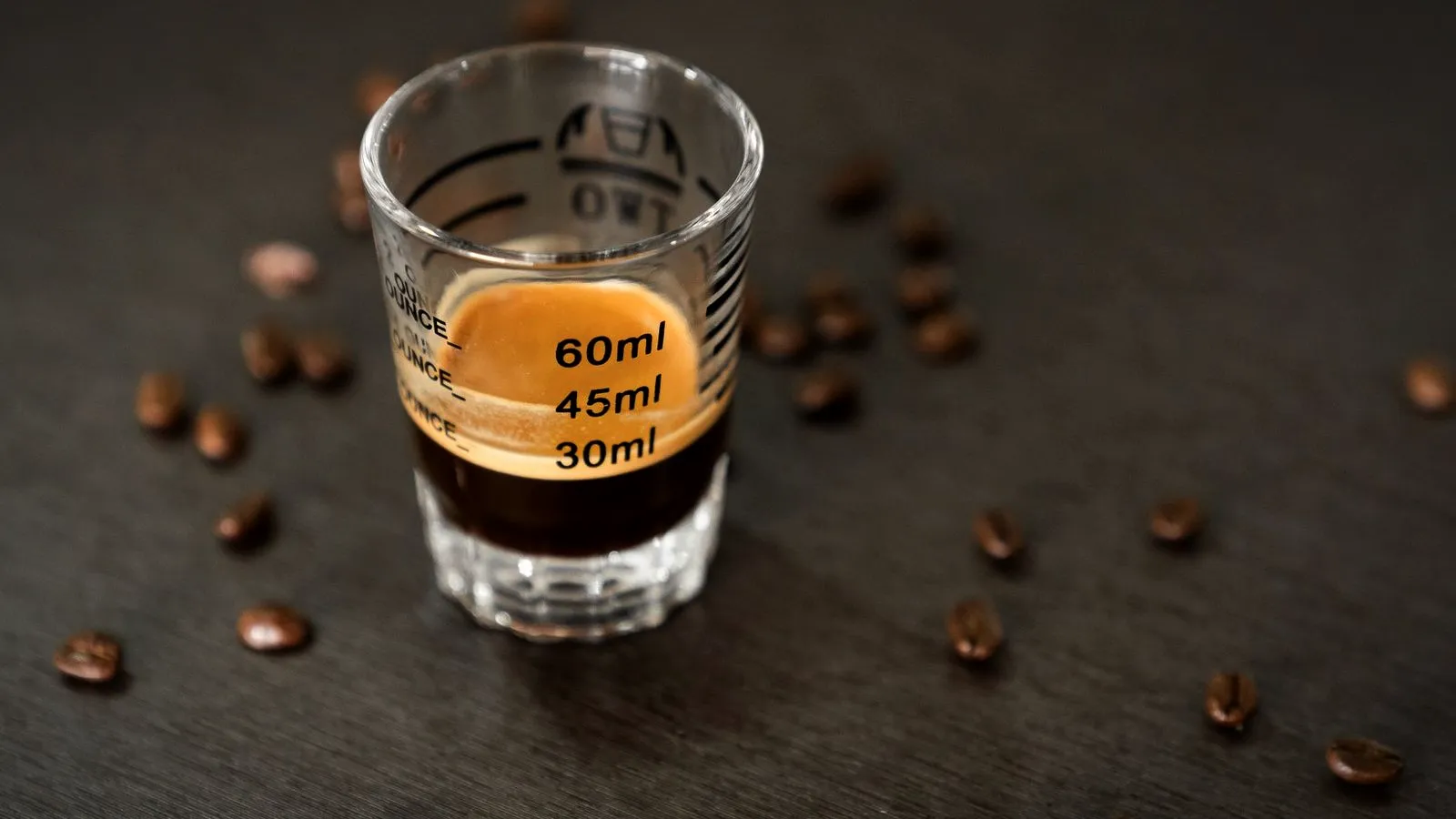
A single shot of espresso has about 63 mg of caffeine on average. USDA FoodData Central lists restaurant-prepared espresso at 212 mg of caffeine per 100 g, and a 1 fl oz serving weighs about 29.6 g, which works out to roughly 63 mg.
What counts as a “shot” is not fixed. The Istituto Espresso Italiano defines a certified Italian espresso as about 25 ml in the cup, slightly less than an ounce. Breville’s machine manual describes a one-cup shot as about 30 ml brewed from roughly 8–11 g of ground coffee. A smaller or lighter-dosed shot will land below the average; a generous one above it.
How much caffeine is in a double shot of espresso?
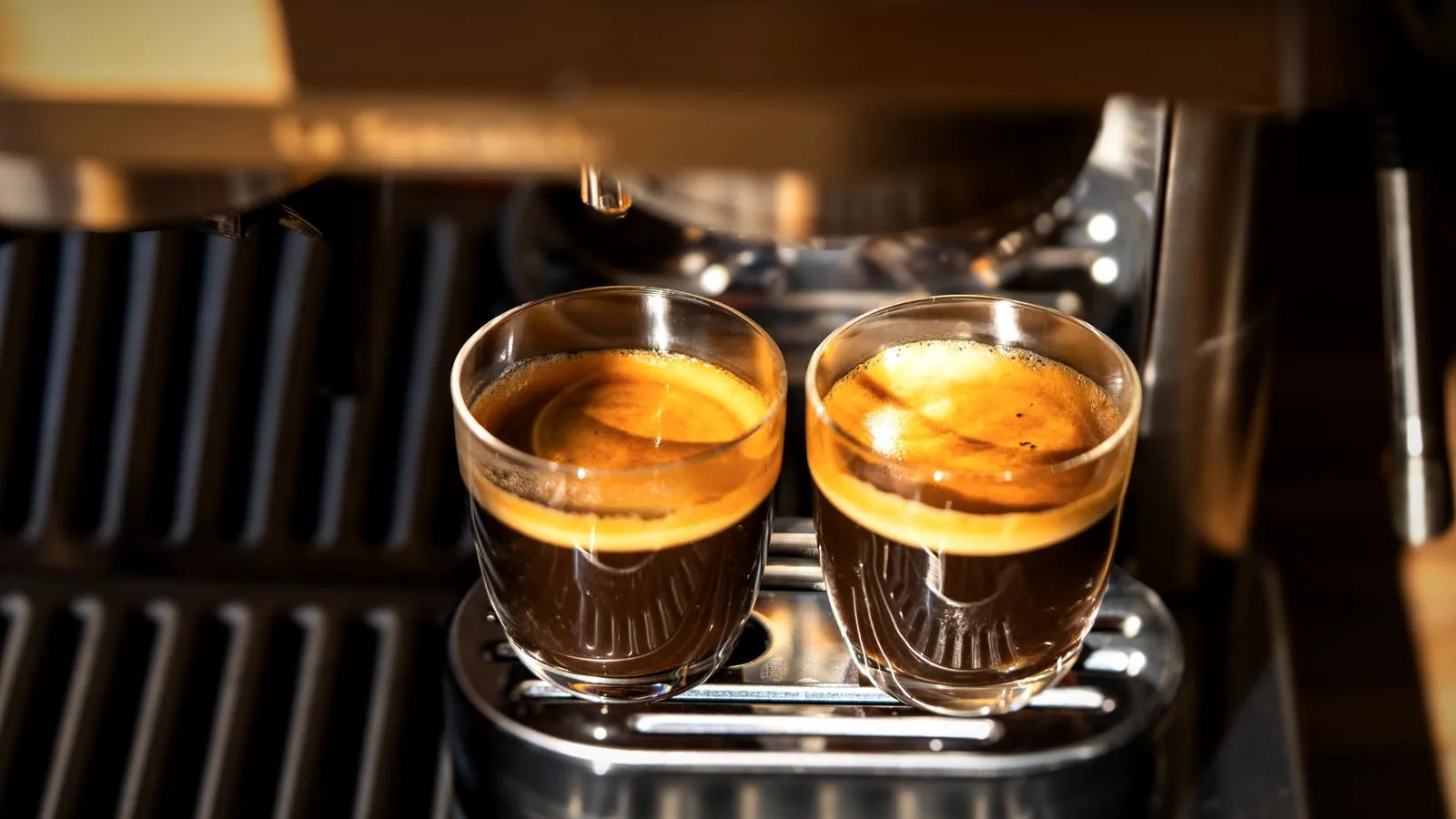
A double shot of espresso, or doppio, has about 126 mg of caffeine: simply two single shots’ worth in about 2 fl oz. Breville’s manual pairs its two-cup basket with roughly 16–19 g of ground coffee and about 60 ml of espresso.
Many cafés and home baristas now use a double as the default shot, so “two shots” is the realistic starting point for many lattes and cappuccinos.
2, 3 and 4 shots of espresso
Caffeine adds up shot by shot: about 126 mg for two average shots, 189 mg for three and 252 mg for four. These are averages. Two cafés can serve a “triple” with very different doses, so use the numbers as a rough guide rather than an exact count.
How much caffeine is in a Starbucks shot of espresso?
A Starbucks shot of its Signature Espresso lists 75 mg of caffeine in a 0.75 fl oz solo, as of October 2026. Each added shot adds another 75 mg:
| Starbucks espresso | Size | Caffeine |
|---|---|---|
| Solo | 0.75 fl oz | 75 mg |
| Doppio | 1.5 fl oz | 150 mg |
| Triple | 2.25 fl oz | 225 mg |
| Quad | 3 fl oz | 300 mg |
That is a smaller shot than USDA’s 1 oz reference but with more caffeine, so it is more concentrated: about 100 mg per ounce (our calculation) against about 63 mg. Starbucks’ Blonde Espresso runs a little higher. Its one-shot Tall Blonde Vanilla Latte lists 85 mg, against 75 mg for a one-shot Tall Caffè Latte.
Ristretto shots, the short pulls Starbucks uses in its Flat White, work out lower. A Tall Flat White with two ristretto shots lists 130 mg, or about 65 mg per shot by simple division. Our comparison of ristretto vs long shot explains why a shorter pull carries less total caffeine.
How much caffeine is in a Nespresso capsule?
Nespresso publishes caffeine as ranges rather than single numbers, because its capsules use different blends and robusta shares. Its help center lists these values per cup:
| Capsule type | Cup size | Caffeine |
|---|---|---|
| Original ristretto and espresso | 25–40 ml | 40–130 mg |
| Original lungo | 110 ml | 70–110 mg |
| Vertuo espresso | 40 ml | 60–150 mg |
| Vertuo double espresso, gran lungo | 80–150 ml | 120–200 mg |
| Original / Vertuo decaf | any | 2–4 mg / 4–12 mg |
So a capsule espresso sits in the same broad range as a café single, with the strongest robusta-heavy capsules above it. Nespresso names four drivers: the blend, the share of robusta, the weight of coffee in the capsule and the length of the extraction.
Why caffeine in an espresso shot varies so much
Lab measurements of real café espresso show far more variation than the average suggests:
- A 2012 study in Food & Function analyzed 20 commercial espressos and found a six-fold difference in caffeine. The strongest single espresso contained 322 mg, and three others exceeded 200 mg.
- A 2014 follow-up tested 104 espressos from coffee shops in Scotland, Italy and Spain and found 48–317 mg of caffeine per serving.
The 2012 researchers concluded that the main driver was likely the amount of coffee used per shot. These are the factors that move the number:
- Dose. More ground coffee means more caffeine. A 19 g double carries more caffeine into the cup than a 14 g one.
- Bean species. Robusta has roughly twice the caffeine of arabica (next section).
- Shot length. A longer pull keeps carrying caffeine into the cup, so a lungo holds more in total than a ristretto from the same dose (details below).
- How the café defines a shot. Some serve 25 ml singles; others pour larger, heavier-dosed shots.
Why a modern double often beats the USDA average
A modern specialty double usually contains more caffeine than USDA’s 126 mg, because it starts from more coffee. A 2023 Technical University of Munich study pulled 20 g doses of 100% arabica to 40 g of espresso and measured an average of 182.6 mg in the cup, from about 172 to 195 mg across its 15 test conditions.
Shot length moved the number more than anything else at that dose. A 1:1 ristretto (20 g of liquid) held about 130 mg and a 1:3 lungo (60 g) about 204 mg. Grind size and flow rate changed the caffeine in the cup only slightly, so fine-tuning the grinder mostly changes taste, not caffeine.
Arabica vs robusta: the bean matters more than the roast
Species is the biggest bean-level factor. In a laboratory comparison of green coffee, arabica beans averaged 1.09% caffeine by weight and robusta beans 2.09%, nearly double.
That means a robusta-heavy blend, common in some traditional Italian espresso, can put far more caffeine into the same size shot than a 100% arabica coffee. Most specialty espresso sold in the US is arabica, but blends labeled simply “espresso” may include robusta. Our guide to espresso beans explains how to read the label.
Does roast level change caffeine?
Very little. The 2014 study above found that caffeine was stable during roasting, while other compounds broke down. A dark roast is not “stronger” in caffeine, even though it tastes more intense.
The only real difference comes from density. Dark beans lose more mass and swell more, so a scoop of dark roast holds slightly less coffee than a scoop of light roast. If you weigh your dose, the difference mostly disappears. For more on how beans are chosen for espresso, see espresso beans vs coffee beans.
Espresso vs drip coffee caffeine: per serving and per ounce
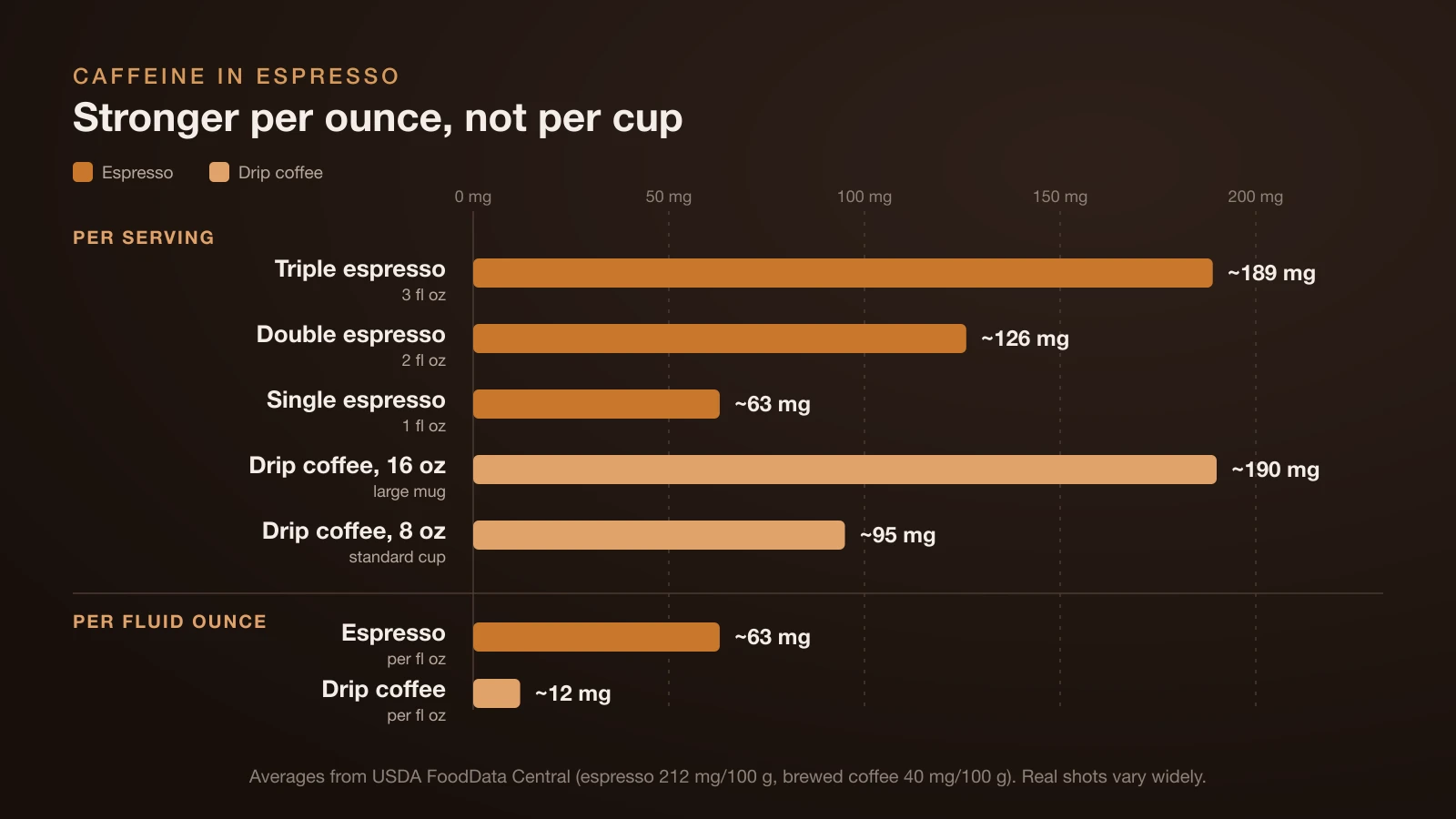
Which has more caffeine depends on how you measure:
| Measure | Espresso | Drip coffee |
|---|---|---|
| Per 100 g (USDA) | 212 mg | 40 mg |
| Per fluid ounce | about 63 mg | about 12 mg |
| Per typical serving | about 63 mg (1 oz single) | about 95 mg (8 oz cup) |
Per ounce, espresso is about five times as concentrated. Per serving, a cup of drip coffee usually wins, because you drink eight times the volume. A double shot (about 126 mg) overtakes an 8 oz cup, but a large 16 oz drip coffee (about 190 mg) still beats a double.
For the full picture on taste, brewing and strength, see our comparison of espresso vs coffee.
Espresso vs tea, soda and energy drinks
A single shot of espresso has about as much caffeine as a 12 oz cup of black tea and less than a typical 12 oz cup of brewed coffee. The FDA publishes typical ranges for common 12 fl oz drinks, which put a shot in context:
| Drink | Serving | Caffeine |
|---|---|---|
| Espresso, single shot (USDA) | 1 fl oz | about 63 mg |
| Regular brewed coffee | 12 fl oz | 113–247 mg |
| Black tea | 12 fl oz | 71 mg |
| Green tea | 12 fl oz | 37 mg |
| Caffeinated soft drink | 12 fl oz | 23–83 mg |
| Energy drink | 16 fl oz | 54–328 mg |
Even a double (about 126 mg) is a moderate serving next to a large brewed coffee or a strong energy drink, though per sip espresso is the most concentrated drink on the list.
Caffeine in espresso drinks
Milk, water, ice and syrup add no caffeine. An espresso drink has exactly the caffeine of the shots inside it:
- Latte, cappuccino, flat white, cortado: usually one or two shots, so about 63–126 mg on average. Our cappuccino caffeine and calories guide lists each size.
- Americano: espresso plus hot water, so the same caffeine as its shots. Our Americano vs espresso guide compares size and strength.
- Macchiato: a shot marked with a little milk foam, so about 63 mg for a single.
A 16 oz latte is not stronger than an 8 oz latte unless it contains more shots; our latte caffeine guide breaks it down by cup size and chain. At home you control the count, and our guide on how to make a latte starts from a double. The types of espresso drinks guide lists the usual shot count for each.
How much caffeine is in a single espresso bean?
Eating whole beans delivers all of their caffeine, since none is left behind in the grounds. Using the species averages above, a gram of arabica contains roughly 11 mg of caffeine and a gram of robusta roughly 21 mg.
A single roasted bean weighs a little over a tenth of a gram. That is an assumption, since bean size varies with origin and roast. On that basis, one arabica bean carries on the order of 1.5 mg of caffeine and one robusta bean about twice that. Chocolate coating adds a small amount more.
How many shots of espresso is too much?
The FDA says 400 mg a day is an amount not generally associated with negative effects for healthy adults, which it describes as about two to three 12 oz cups of coffee. At the USDA average of about 63 mg per shot, that is roughly six single shots or three doubles, counting no other caffeine from tea, soda or chocolate.
Because café shots can contain far more than the average, the same number of drinks can add up faster than you expect. Two home doubles pulled from 20 g of arabica (about 183 mg each in the study above) already come to about 365 mg.
The FDA notes that people who are pregnant, trying to become pregnant or breastfeeding should talk with a healthcare provider about caffeine, and that sensitivity varies from person to person. It also warns that toxic effects such as seizures can appear with rapid consumption of around 1,200 mg, in the context of pure and highly concentrated caffeine products. This is general information, not medical advice.
How to estimate the caffeine in your own shot
If you make espresso at home, you can get closer than the average with a scale and two numbers:
- Weigh your dose of ground coffee in grams.
- Find the ceiling. Use about 11 mg of caffeine per gram for 100% arabica (from the 1.09% species average), more for blends with robusta. An 18 g arabica dose holds roughly 200 mg.
- Estimate what reaches the cup. In the Munich study, a standard 1:2 shot carried about 9 mg of caffeine per gram of arabica dose (182.6 mg from 20 g). For 18 g, that suggests about 165 mg.
- Adjust for shot length. A 1:1 ristretto lands nearer 6.5 mg per gram of dose and a 1:3 lungo nearer 10 mg, using the same study’s averages.
These per-gram figures are our estimates from one lab’s arabica, not a measurement of your coffee. They are still far closer than a single generic number when your dose is well above or below average.
The bottom line
An average single shot of espresso has about 63 mg of caffeine, and a double about 126 mg, but a Starbucks solo lists 75 mg and a home double from 20 g of arabica can reach about 183 mg. Espresso is far more concentrated than drip coffee per ounce, yet a regular cup of coffee usually contains more caffeine per serving. The dose in the basket, the share of robusta and the length of the shot move the number most; roast level barely does.
Sources
- USDA FoodData Central: Coffee, brewed, espresso, restaurant-prepared and Coffee, brewed, prepared with tap water (212 mg and 40 mg caffeine per 100 g; 1 fl oz espresso = 29.6 g)
- Peer-reviewed studies: Food & Function, Crozier et al. (2012) and Ludwig et al. (2014); Foods, Schmieder et al. (2023) (caffeine by shot length from a 20 g dose); Biotropia, arabica and robusta green beans (1.09% vs 2.09% caffeine)
- U.S. Food and Drug Administration: Spilling the Beans: How Much Caffeine Is Too Much? (400 mg a day; typical caffeine by drink)
- Starbucks nutrition, as of October 2026: Espresso, Caffè Latte, Blonde Vanilla Latte and Flat White
- Manufacturer data: Nespresso, caffeine content of capsules; Breville, Barista Express BES875 instruction book (doses and shot volume); Istituto Espresso Italiano, Certified Italian Espresso (about 25 ml in the cup)