
Cortado vs latte is a question of milk. A cortado is espresso “cut” with roughly the same amount of warm milk, usually around 4 ounces in total. A latte is espresso with several times as much steamed milk and a thin layer of foam, usually 8 ounces or more. The cortado tastes bold and coffee-forward; the latte tastes mild and creamy.
Both use the same espresso, so a double cortado and a double latte carry the same caffeine. The real choice is between concentration and volume: a few strong, warm sips or a large, mild cup to drink slowly. For the full lineup of café drinks, see our types of espresso drinks chart.
The short answer
| Cortado | Latte | |
|---|---|---|
| What it is | Espresso cut with about equal warm milk | Espresso with lots of steamed milk and a thin foam layer |
| Typical espresso to milk | About 1:1 | About 1:3 to 1:5, more in large sizes |
| Typical size | About 4–4.5 oz | 8–20 oz |
| Milk texture | Warm, silky, little or no foam | Steamed, with a thin layer of microfoam |
| Served in | Small glass or small cup | Large cup or glass |
| Taste | Balanced but coffee-forward | Mild, creamy, sweeter |
| Caffeine | Same as the shots inside | Same as the shots inside |
| Origin | Spain | Italy (as caffè latte) |
Ratios and sizes vary a lot from café to café, and even more between countries. Read these as typical ranges, not fixed recipes.
What is the difference between a cortado and a latte?
The difference between a cortado and a latte is how much the milk dilutes the espresso.
- Cortado: from the Spanish cortar, “to cut,” in the sense of diluting. The espresso is cut with about the same amount of warm milk, which takes the edge off its acidity without hiding the coffee.
- Latte: short for caffè latte, “milk coffee.” The espresso is topped with a large amount of steamed milk and finished with microfoam, so milk is the main ingredient.
Put simply: a cortado is an espresso drink softened by milk. A latte is a milk drink flavored with espresso.
Cortado vs latte: ratio and size
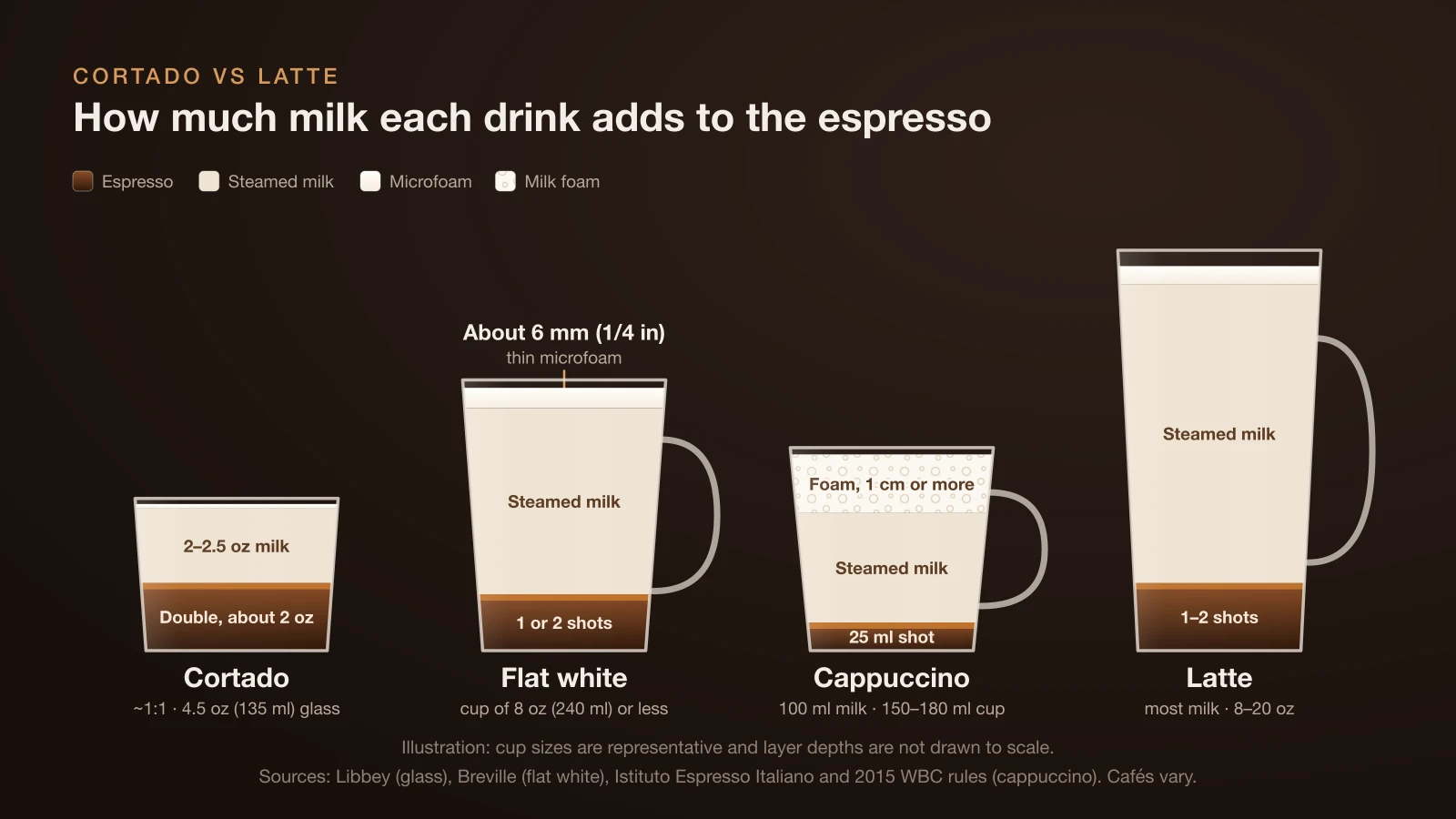
The ratio explains almost everything about the taste. In a 4.5 oz cortado glass, a double shot of about 2 oz leaves room for roughly the same amount of milk. A latte starts with the same shot and adds 6–12 oz or more of milk. The flat white and cappuccino, also shown in the diagram, sit between the two in size.
| Cortado | Latte | |
|---|---|---|
| Espresso | Usually a double, about 2 oz | 1–2 shots, 1–2 oz |
| Milk | About 2–2.5 oz | 6–12 oz or more |
| Foam | Little or none | A thin layer |
| Total | About 4–4.5 oz | 8–20 oz |
The Gibraltar glass
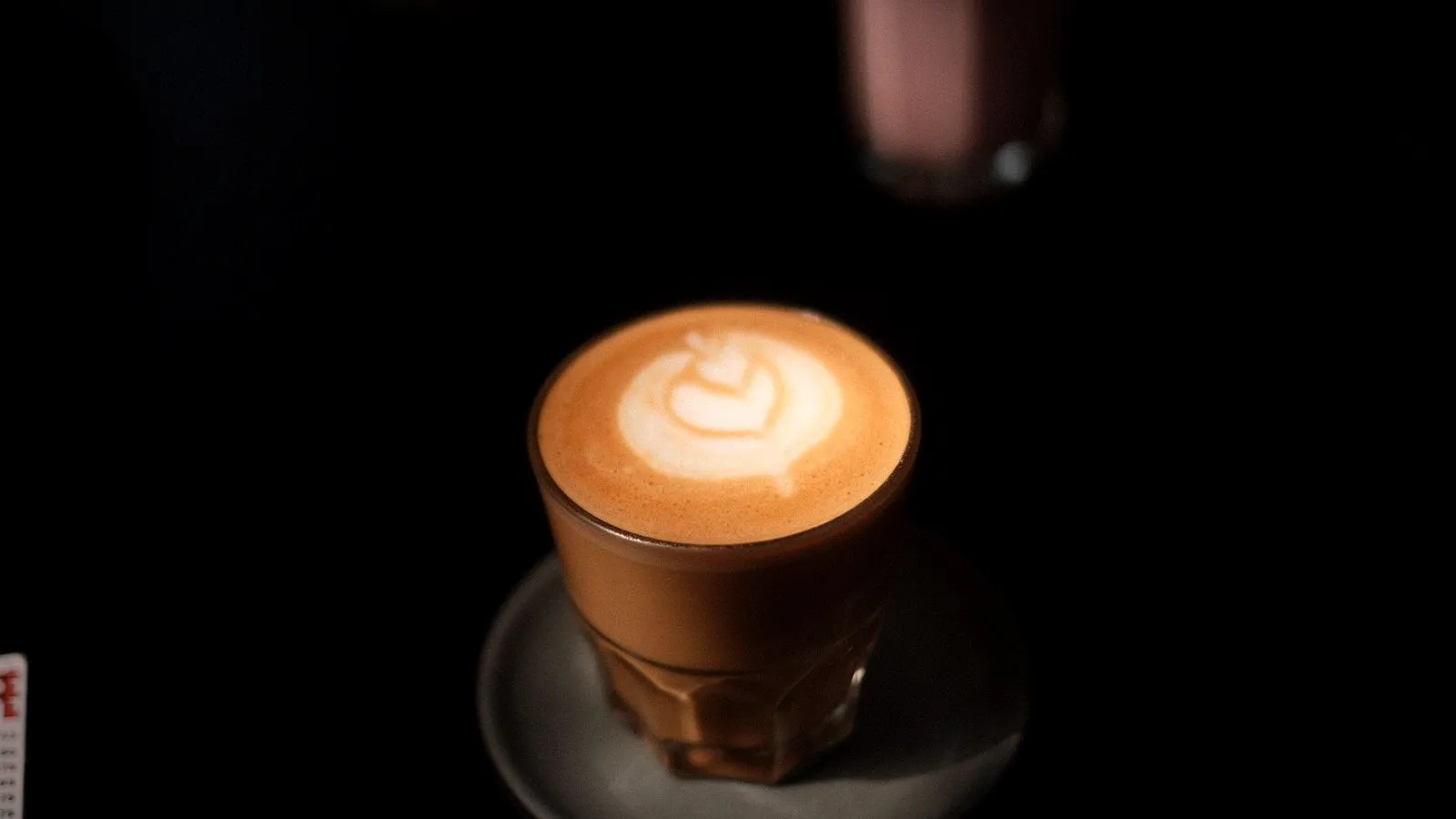
In the US, cortados are often served in a small, heavy glass. Libbey sells its 4.5 oz (about 135 ml) Gibraltar glass as a cortado glass, and some cafés name the drink a Gibraltar after it. That glass holds a double shot of about 2 oz plus a similar amount of milk, so a Gibraltar is essentially a cortado named after its glass.
A latte, by contrast, goes into a large mug or a tall glass of 8 oz or more. Our guide to ceramic espresso cups covers which cup size suits which drink.
Milk texture
Both drinks use milk heated with a steam wand, but it is handled differently.
- Cortado: the milk is warmed and lightly textured, with little or no foam. It should blend into the espresso rather than sit on top.
- Latte: the milk is steamed and stretched briefly to create glossy microfoam. Most of the drink is silky liquid milk, with a thin foam layer that allows latte art.
Getting the texture right is mostly about temperature and air. Our guide to steaming milk for espresso drinks explains how, and how to make a latte walks through the full recipe.
Is a cortado stronger than a latte?
In flavor, yes. In caffeine, not necessarily. Milk adds volume, not caffeine, so all the caffeine in both drinks comes from the espresso.
USDA data puts espresso at about 212 mg of caffeine per 100 g, or roughly 63 mg in a 1 oz shot. A double shot is therefore around 126 mg, whether it goes into a 4 oz cortado or a 16 oz latte. Café shots vary with dose and beans, so treat that as a ballpark.
What does change is concentration. In a cortado, about half the drink is espresso; in a large latte, it can be less than a sixth. That is why the cortado tastes much stronger. For per-shot details, see how much caffeine is in espresso.
Cortado vs flat white
This is the comparison people mix up most, because both are small, strong milk drinks.
| Cortado | Flat white | |
|---|---|---|
| Espresso | Usually a double | A single or double shot |
| Milk | About equal to the espresso | More than a cortado, less than a latte |
| Foam | Little or none | A thin layer of microfoam, about 1/4 inch (6 mm) |
| Size | About 4–4.5 oz | A cup of 8 oz or less |
| Origin | Spain | Australia and New Zealand (both claim it) |
A flat white is the creamier of the two, with a velvety texture from its microfoam. A cortado is smaller and stronger, with the milk simply cutting the espresso.
Cortado vs cappuccino
A cappuccino is defined by its foam. The Italian Espresso Institute’s certified cappuccino uses 25 ml of espresso and 100 ml of steamed milk, with a thick, fine-textured foam on top. World Barista Championship rules called for a single shot in a 150–180 ml cappuccino with at least 1 cm of foam.
- Cortado: about equal espresso and milk, flat surface, little foam.
- Cappuccino: more milk than espresso and a thick, airy cap of foam, served in a small cup.
The cappuccino feels lighter and airier; the cortado feels denser and tastes more of coffee. If you like the strength of a cortado but want some foam, a cappuccino is the closest step up.
Cortado vs macchiato
These two sit next to each other at the strong end of the menu, and the difference is quantity.
- Espresso macchiato: a shot “marked” with a spoonful or two of milk foam. It tastes almost like straight espresso.
- Cortado: the same shot with roughly an equal volume of warm milk. It is noticeably softer and smoother.
If a macchiato is too sharp and a latte too milky, the cortado is the drink in between. We compare the macchiato with the latte in detail in macchiato vs latte.
Where the cortado comes from
The cortado comes from Spain, where it is an everyday café order and the amount of milk varies from one bar to the next. Starbucks traces the drink to Spain’s Basque Country more than a century ago. Our guide to what a cortado is covers the drink on its own.
Two variations are common in the US:
- Cortadito: the Cuban version, popular in Miami. It is made with sweetened Cuban-style espresso, so it is much sweeter than a Spanish cortado.
- Gibraltar: a café name for a cortado served in the 4.5 oz Gibraltar glass, as described above.
Starbucks Cortado vs Caffè Latte
The Starbucks Cortado is three ristretto shots of Blonde Espresso cut with steamed whole milk, served hot in a short (8 oz) cup, while a short Starbucks Caffè Latte uses one regular shot in the same size cup. Starbucks added the Cortado to its permanent US menu in January 2025, along with a Brown Sugar Oatmilk Cortado; shot counts for the latte come from its Caffè Latte menu page.
| Starbucks Cortado | Starbucks Caffè Latte | |
|---|---|---|
| Espresso | 3 ristretto shots, Blonde Espresso | 1 shot in a short or tall, 2 in a grande |
| Milk | Steamed whole milk (or milk of choice) | Steamed 2% milk, thin foam |
| Sizes | Short (8 oz) only, hot only | Short to venti, hot or iced |
A ristretto is a shorter pull of the same dose, so it tastes sweeter and more concentrated than a regular shot. Starbucks’ version is therefore larger than a traditional 4.5 oz cortado but far more concentrated than any of its lattes. If you want the classic proportions, ask for a double shot with an equal amount of steamed milk. Our ristretto vs long shot guide explains how a ristretto differs.
How to make a cortado vs a latte at home
You make a cortado and a latte with the same shot and the same steam wand; only the amount of milk and the amount of air change.
| Step | Cortado | Latte |
|---|---|---|
| Shot | Double, about 2 oz | Same double shot, or a single for a small cup |
| Cup | 4.5 oz glass | 10–12 oz cup or glass |
| Milk in the pitcher | About 3–4 oz, the least your wand can steam | About 6–8 oz |
| Air | Almost none: a second or two, then keep the tip under the surface | A few seconds of air for a thin foam layer |
| Heat | Until the pitcher is just too hot to hold | The same |
| Pour | About 2 oz of milk, to roughly equal parts | Fill the cup, finishing with the foam |
The hardest part of a cortado at home is steaming so little milk. Use your smallest pitcher and steam a little more than you need; the leftover is normal. Without a machine, strong moka pot coffee works for both: about equal parts warm milk for a cortado and about three parts milk for a latte. Our guides to steaming milk and using an espresso machine cover the technique.
Calories: cortado vs latte
Almost all the calories come from the milk. Using USDA figures for whole milk (61 kcal per 100 g, about 30.5 g per fluid ounce), here is a rough estimate:
- Cortado with 2 oz of whole milk: about 37 kcal from the milk, so roughly 40 kcal in total.
- Latte with 8 oz of whole milk: a cup of whole milk (244 g) is about 150 kcal, so a small latte lands around 150–160 kcal.
These estimates assume plain whole milk and no syrup. Skim or plant milk lowers the numbers; larger sizes and flavored syrups raise them a lot.
Which should you order?
| Choose a cortado if you… | Choose a latte if you… |
|---|---|
| Want to taste the espresso clearly | Prefer a mild, creamy drink |
| Like a small drink you finish quickly | Want a large drink to sip slowly |
| Find straight espresso too sharp | Find strong coffee too bitter |
| Want fewer calories from milk | Want a base for syrups, spices or latte art |
A cortado also suits plain, unsweetened coffee drinkers, because there is too little milk to balance a pump of syrup. A latte has the volume to carry flavors such as vanilla or caramel without tasting cloying.
The bottom line
A cortado is espresso cut with about equal warm milk: small, balanced and coffee-forward. A latte is espresso with plenty of steamed milk: large, mild and creamy. With the same shots, both carry the same caffeine. Among the neighbors, the macchiato is stronger, and the flat white and cappuccino are milkier and foamier than a cortado.
Sources
- USDA FoodData Central: Beverages, coffee, brewed, espresso, restaurant-prepared (212 mg caffeine per 100 g) and Milk, whole, 3.25% milkfat (61 kcal per 100 g; 1 fl oz = 30.5 g; 1 cup = 244 g)
- Istituto Espresso Italiano: Certified Italian Espresso and Cappuccino (25 ml espresso + 100 ml milk)
- World Coffee Events: 2015 World Barista Championship Rules and Regulations (archived; cappuccino made with one single shot, 150–180 ml, at least 1 cm of foam)
- Libbey: Gibraltar DuraTuff cortado glasses, 4.5 oz (glass size, sold for cortados)
- Breville: How to make a flat white at home (single or double shot, cup of 8 oz or less, microfoam about a quarter inch thick, claimed by Australia and New Zealand)