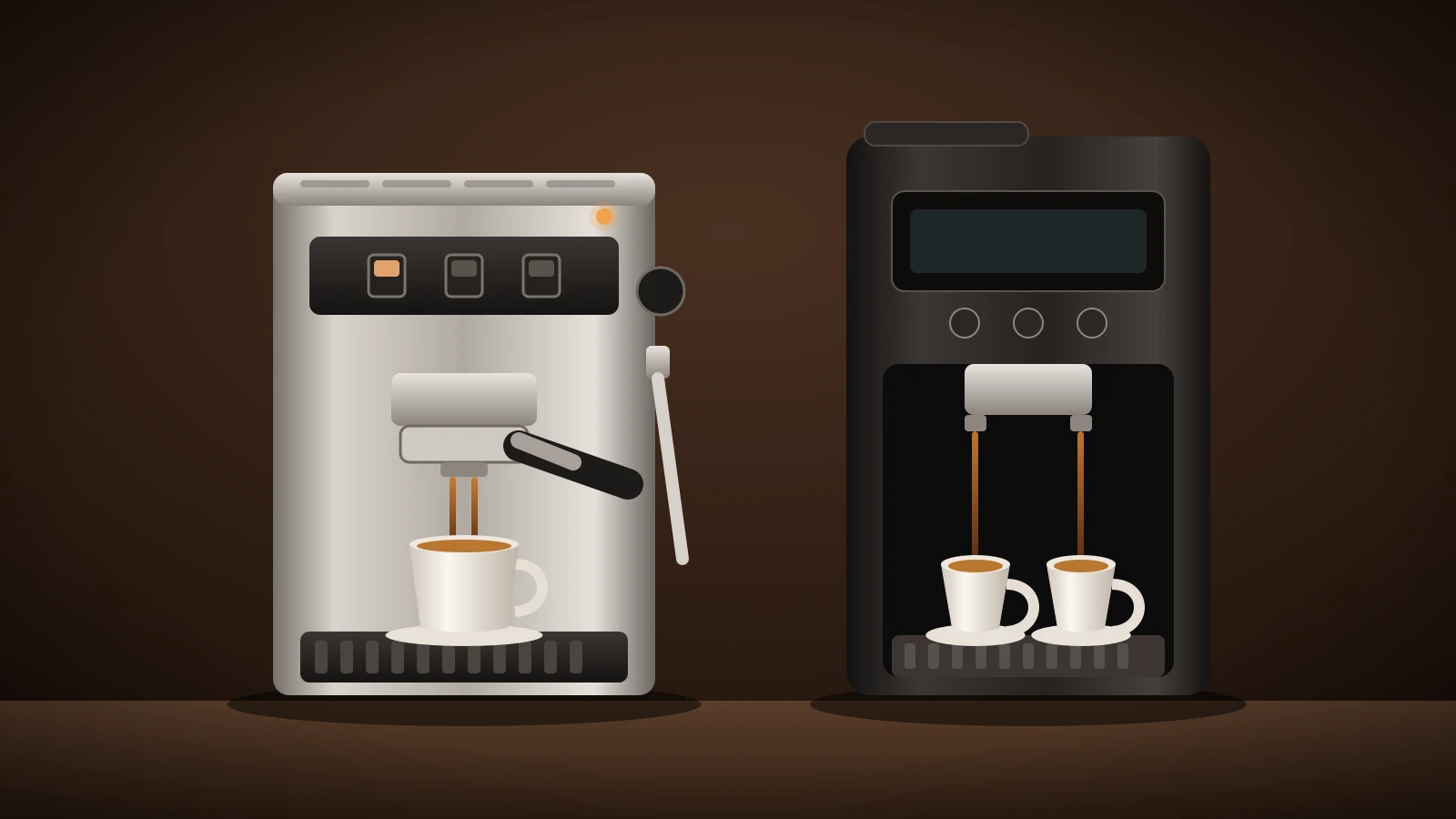

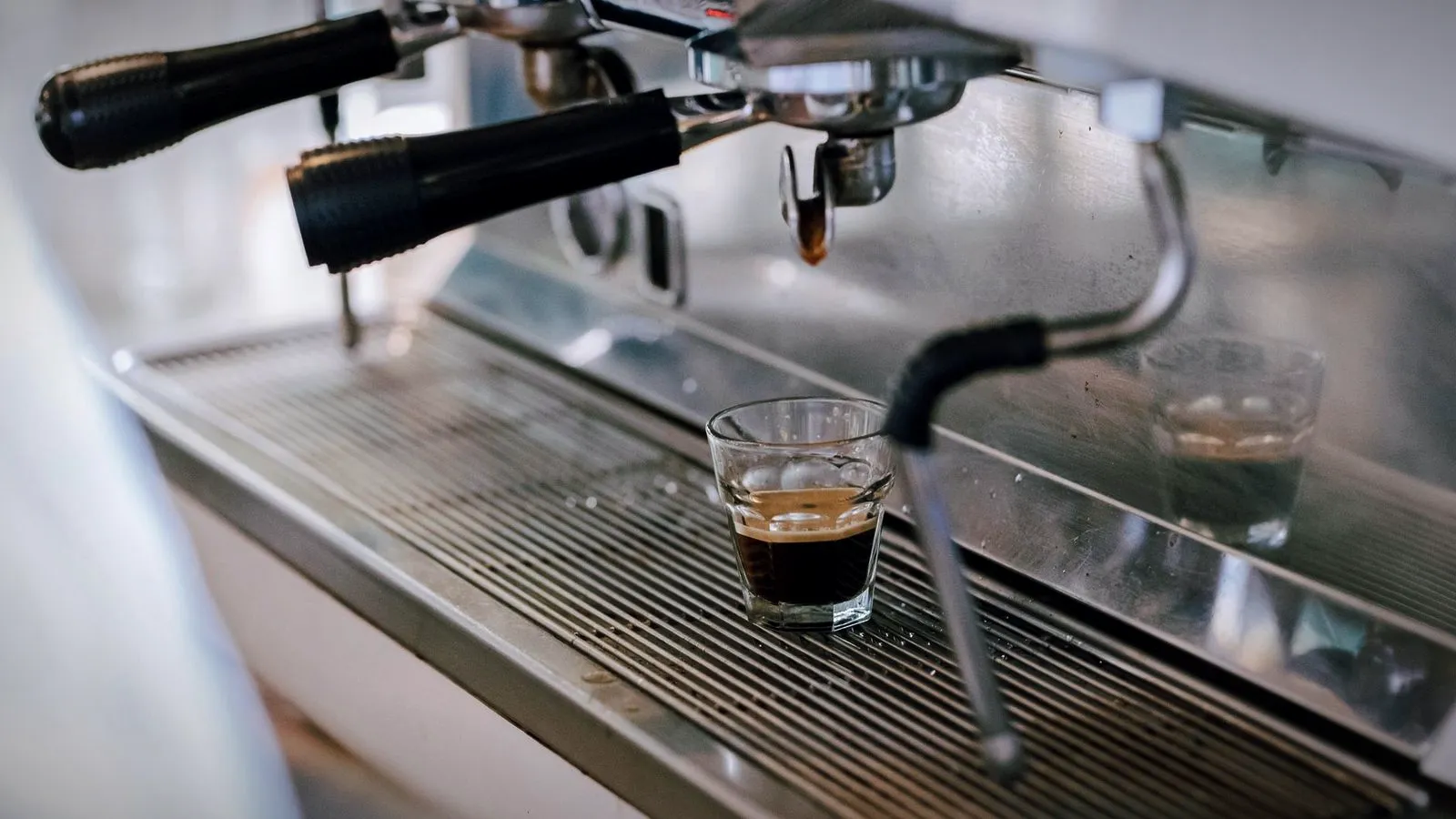
The main parts of an espresso machine are the water tank, pump, boiler (or thermoblock), group head, group gasket, shower screen, portafilter and basket, steam wand and drip tray, with valves and a PID or pressurestat inside. Espresso machine parts fall into three groups: water and heating, brewing at the group head, and steam. The gasket and shower screen wear fastest; La Marzocco schedules them every 6–12 months.
Knowing the part names helps you trace a leak or a weak shot, read a manual and order the right replacement.
Espresso machine parts names: the full list
Every pump espresso machine is built from roughly the same named parts, though makers label a few of them differently. The table lists each part name, other names you will see in manuals and shops, and what the part does.
| Part name | Also called | What it does |
|---|---|---|
| Water tank | Reservoir | Holds the water the pump draws from |
| Water filter | Filter cartridge | Sits in the tank and reduces scale |
| Water line connection | Plumbed-in feed | Replaces the tank on plumbable machines |
| Pump | Vibration pump, rotary pump | Pressurizes water for brewing |
| Boiler | Brew boiler, steam boiler | Heats and stores water |
| Heat exchanger | HX | Tube in the steam boiler that heats brew water on its way through |
| Thermoblock | Thermocoil, ThermoJet | Heats water on demand instead of storing it |
| Over-pressure valve | OPV | Caps the pressure that reaches the coffee |
| PID controller | Electronic thermostat | Holds the brew or boiler temperature |
| Pressurestat | Pressure switch | Switches the heater on and off by boiler pressure |
| Safety valve and thermostats | Safety devices | Vent pressure or cut power if the heater overheats |
| Group head | Brew group, group | Delivers hot water to the coffee; the portafilter locks in here |
| Solenoid valve | Three-way valve, exhaust valve | Releases pressure from the group after the shot |
| Group gasket | Group seal, silicone seal | Seals the portafilter against the group |
| Shower screen | Dispersion screen, diffuser screen | Spreads water evenly over the coffee |
| Shower screen screw | Dispersion screw | Holds the screen in the group |
| Portafilter | Group handle, filter holder | Holds the basket and locks into the group |
| Filter basket | Basket, filter | Perforated cup that holds the ground coffee |
| Steam wand | Steam arm | Injects steam to heat and texture milk |
| Steam tip | Steam nozzle | Holed tip that shapes the steam jet |
| Hot water outlet | Hot water spout | Dispenses hot water for tea or Americanos |
| Pressure gauge | Manometer | Shows brew or boiler pressure |
| Drip tray | Drip tray and grate | Catches drips and water released from the group |
| Controls | Buttons, dials, power switch | Start shots, select steam and set volumes |
Machines with a built-in grinder add more names: Breville’s Barista Express parts list, for example, includes a bean hopper, an integrated conical burr grinder, a grind size selector, a grind amount dial and a 54 mm tamper, alongside the group head, portafilter, steam wand and drip tray. An espresso machine with grinder explains how those built-ins compare with a separate grinder.
Parts of an espresso machine at a glance
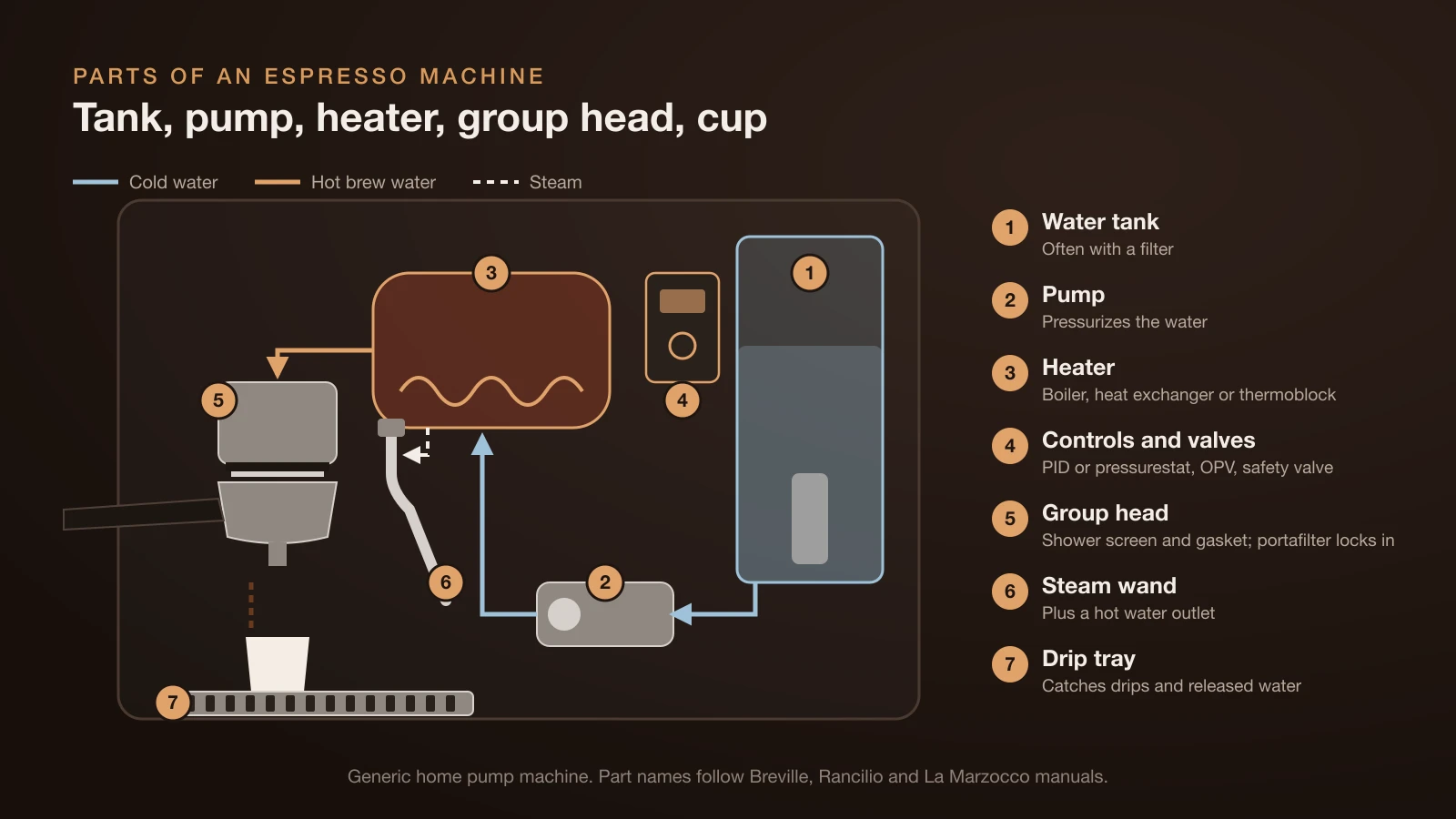
An espresso machine moves water from the tank through a pump and a heater to the group head, then through the coffee into the cup, with a separate steam circuit for milk.
Following the water path is the easiest way to remember the names of the parts in order:
- Water tank or water line, often with a filter.
- Pump, which pressurizes the water.
- Heater: boiler, heat exchanger or thermoblock.
- Controls and valves: PID or pressurestat, OPV, safety valve.
- Group head, with shower screen and gasket, where the portafilter locks in.
- Steam wand and hot water outlet for milk and tea water.
- Drip tray for drips and released water.
How to find the right espresso machine parts
The right part starts with your exact model number, not the model name, because makers change parts between versions. Check these points before you order from any shop.
- Read the rating label. The model number and voltage are printed on it; check the base and the back panel, and note the serial number too.
- Open the manual. It names each part (Breville’s Barista Express manual labels them A to Y) and often shows the replacement procedure.
- Ask the maker first. Breville’s manual tells owners to contact Breville Consumer Support or breville.com for replacement silicone seals.
- Match dimensions for generic parts. Gaskets and shower screens are sized by diameter and thickness; baskets by portafilter size.
- Leave internal parts to a technician. Gaggia says the Classic Pro has no user-serviceable parts inside, and Rancilio reserves pump pressure adjustment on the Silvia for a qualified technician.
Water and heating parts
The water and heating parts store, heat and stabilize the water, and decide whether a machine can brew and steam at once.
Water tank and filter
The tank feeds the pump, and many machines fit a filter inside it. Breville’s Barista Express has a 67 oz (2 L) tank and a filter it says to replace every two months to reduce scale; the Dual Boiler takes a 2.5 L tank and a filter replaced after three months or 40 L.
Boiler, heat exchanger or thermoblock
The heater is the biggest difference between machines. A single boiler heats one small tank for both jobs: the Rancilio Silvia’s holds 0.3 L. A heat exchanger, like Rocket’s 1.8 L boiler in the Appartamento, keeps one boiler at steam temperature and heats brew water in a tube passing through it. A dual boiler, such as Breville’s Dual Boiler with its 950 ml steam boiler, gives each job its own boiler.
A thermoblock or thermocoil heats water on the way to the group instead of storing it; Breville’s Thermocoil is an integrated stainless steel water coil. Our guide to high-end espresso machines compares these heating systems in depth.
Pump
The pump pressurizes the water for brewing. Breville lists a 15 bar Italian pump on the Barista Express, which still brews at about 9 bar because a valve and the coffee puck limit what reaches the cup. Higher-end machines often use a rotary pump instead; Rocket Espresso USA says the rotary pump in its R Cinquantotto offers longer service life and allows plumbing to a water line.
Over-pressure valve (OPV)
The OPV caps how much pressure reaches the coffee, whatever the pump could deliver. Breville’s Dual Boiler manual says its OPV limits maximum pressure for optimal espresso flavor. To see what your pump and OPV deliver during a shot, read our guide to the espresso machine pressure gauge.
PID and pressurestat
A PID (proportional-integral-derivative) controller is an electronic thermostat that keeps adjusting the heater to hold a set temperature; Breville fits one to the Barista Express for temperature stability. A pressurestat is the older mechanical alternative on many heat exchanger machines: a switch that turns the heater on and off as boiler pressure rises and falls. Rocket shows the change in its own range: the original Appartamento lists no PID pressure control, while the Appartamento TCA uses a PID to set boiler pressure from 0.9 to 1.2 bar.
Safety parts
Boiler machines carry protection you should never bypass. Rancilio’s Silvia wiring diagram lists a safety valve and three safety thermostats (100 °C, 140 °C and 165 °C, or 212 °F, 284 °F and 329 °F). La Marzocco schedules the Linea Micra’s safety valve and expansion valve for replacement every 4 years, or sooner where local rules require.
Brewing parts at the group head
The group head is where the machine meets the coffee, and its parts are the ones you clean and replace most often.
Group head and solenoid valve
The group head receives hot water and delivers it to the portafilter. Breville’s Dual Boiler uses a heated 58 mm group head; Rocket machines use the E61 group. Many machines add a three-way solenoid valve that releases pressure after the shot: Rancilio lists a group solenoid valve on the Silvia, and Rocket’s cleaning guide describes backflush water leaving through the exhaust solenoid into the drip tray.
Group gasket
The gasket is the rubber or silicone ring the portafilter ears press against, sealing the brew chamber. It hardens over time and starts to leak: Gaggia’s troubleshooting table checks for a dirty seal when water escapes around the filter holder. Rancilio’s daily routine is to brush the seal under the group head.
Shower screen
The shower screen, sometimes called a diffuser screen, is the fine mesh that spreads water evenly over the coffee. Breville tells owners to wipe the group interior and shower screen with a damp cloth, and Rancilio warns against brushing the screen itself. La Marzocco replaces it together with the gasket.
Portafilter and basket
The portafilter locks into the group and holds the basket of coffee; a spring clip keeps the basket in place. La Marzocco checks baskets and the spring at the Micra’s yearly service. Sizes, basket types and fit are covered in our guide to portafilter sizes.
Steam and hot water parts
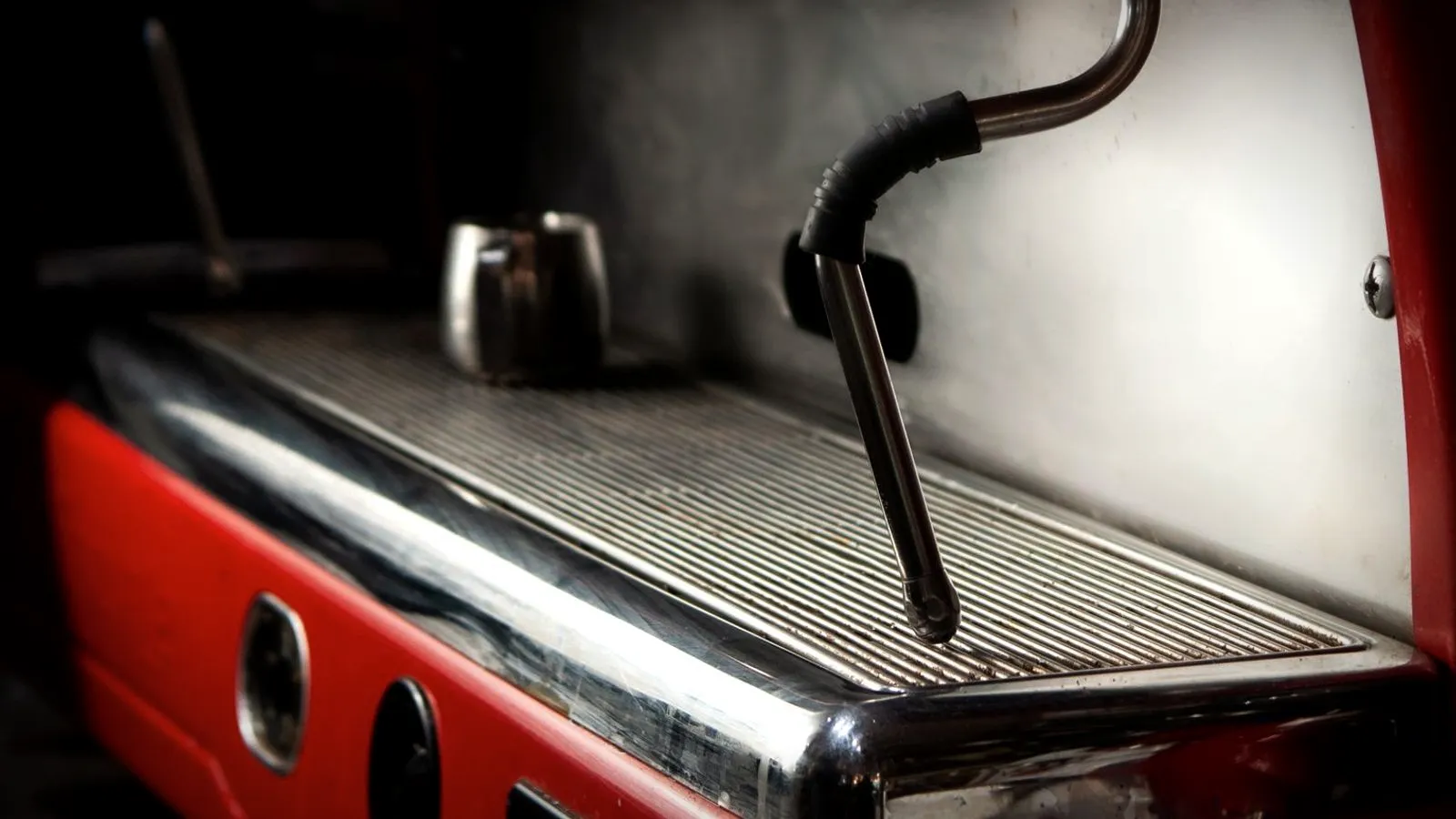
The steam wand and hot water outlet draw from the heater, and the wand needs cleaning after every use because milk dries inside it.
Breville says to wipe the wand and purge steam after texturing milk, and to clear blocked tip holes with the pin on its cleaning tool. Gaggia lets you unscrew the nozzle of the Classic Pro to rinse it. La Marzocco fits a steam valve rebuild kit to the Linea Micra every 2 years. For technique, see our guide on how to steam milk.
Which espresso machine parts wear out, and when
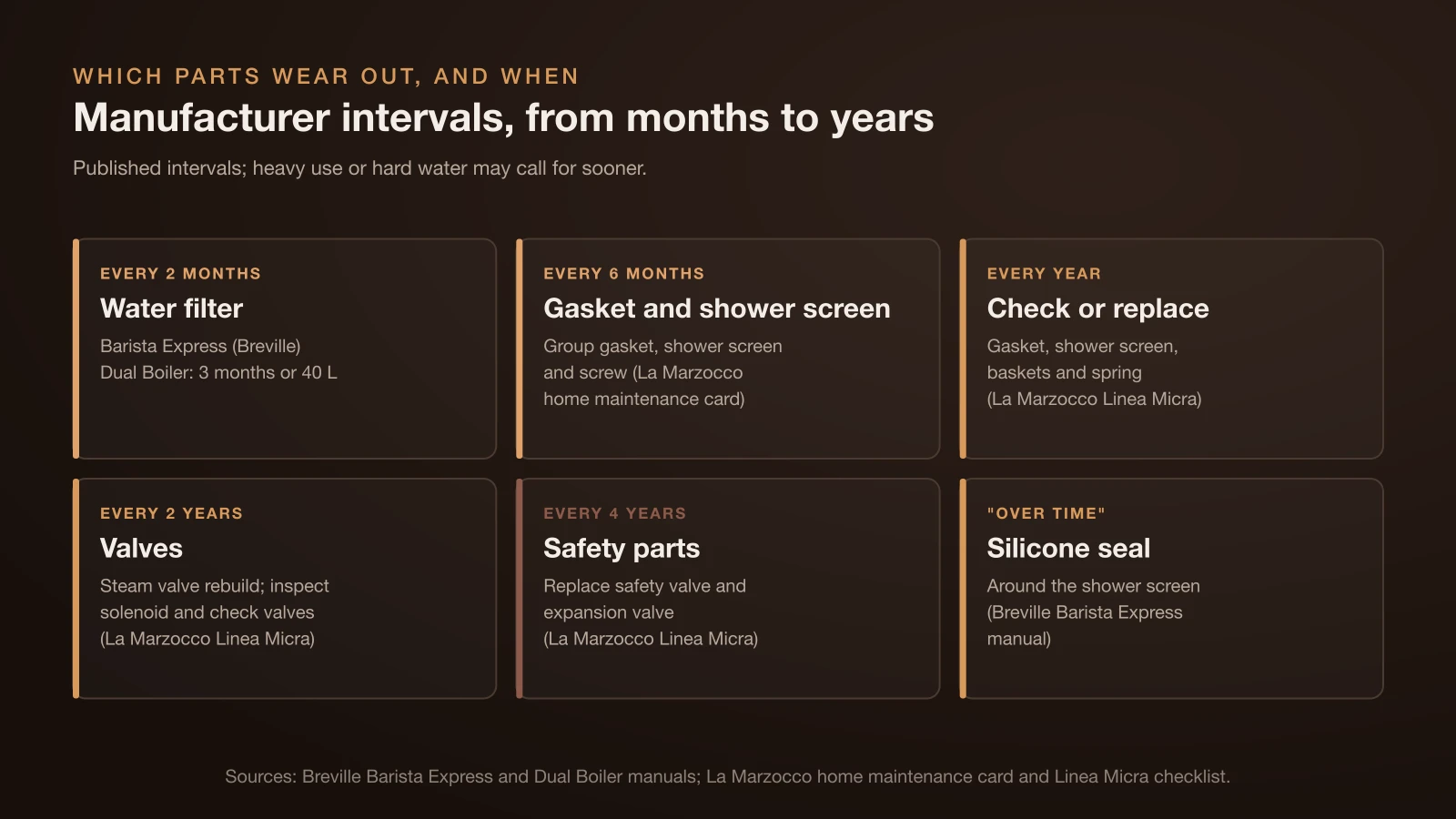
The parts that wear out are the soft seals, the screen and filter that touch coffee and water, and the valves that cycle thousands of times. The intervals below are the ones manufacturers publish; your use and water may call for sooner.
| Interval | Part | Source |
|---|---|---|
| Every 2 months | Water filter (Barista Express) | Breville |
| 3 months or 40 L | Water filter (Dual Boiler) | Breville |
| Every 6 months | Group gasket, shower screen and screw | La Marzocco home maintenance card |
| Every year | Check or replace gasket, shower screen, baskets and spring | La Marzocco Linea Micra checklist |
| Every 2 years | Steam valve rebuild; inspect solenoid and check valves | La Marzocco Linea Micra checklist |
| Every 4 years | Replace safety valve and expansion valve | La Marzocco Linea Micra checklist |
| “Over time” | Silicone seal around the shower screen | Breville Barista Express manual |
Scale and coffee oils shorten the life of every part here. Regular backflushing keeps the group and solenoid clean, and following the schedule in our guide on how to descale an espresso machine protects the heater and valves.
Which parts you can replace yourself
You can replace the front-end wear parts yourself: gasket, shower screen, baskets, steam tip and water filter. Breville’s manual changes the seal with the supplied Allen key; La Marzocco’s card uses a gasket pick and a short screwdriver.
- Switch off, unplug and let the machine cool before touching the group.
- Remove the screw and shower screen, noting which side faces down.
- Pry out the old gasket with a pick or long-nose pliers.
- Fit the new gasket the way the manual shows (Breville: flat side first, ribbed side facing you).
- Refit the screen and screw finger tight; La Marzocco warns that overtightening can warp the screen.
- Seat the gasket by locking the portafilter in a few times.
Leave the pump, boilers, valves, thermostats and wiring to an authorized service center. Gaggia says repairs inside the Classic Pro are for authorized service personnel only, and Rancilio reserves pump pressure adjustment on the Silvia for a qualified technician.
The bottom line
An espresso machine is a short path from tank to pump, heater, group head and cup. The group gasket and shower screen wear first, and La Marzocco publishes intervals from every 6 months to yearly for them, with filters, valves and safety parts on longer schedules. Find parts by your exact model number, replace the front-end wear parts yourself, and leave internal repairs to a technician.
Sources
- Breville: Barista Express BES870 instruction book (parts list, 15 bar Italian pump, Thermocoil, PID, 2 L tank, filter every two months, silicone seal replacement with Allen key, shower screen and steam wand cleaning, drip tray), Barista Express product page (9 bar extraction) and Dual Boiler BES920 instruction book (heated 58 mm group, OPV, PID, 950 ml steam boiler, 2.5 L tank, filter after three months or 40 L)
- La Marzocco: Home preventative maintenance card (gasket, shower screen and screw every 6 months, gasket pick, do not overtighten) and Linea Micra preventative maintenance checklist (1, 2 and 4 year items)
- Rancilio: Silvia user manual (0.3 L boiler, group solenoid valve, safety valve and thermostats, brushing the seal, pump adjustment by a qualified technician)
- Gaggia: Classic Pro operating instructions (no user-serviceable parts inside, steam nozzle removal, seal troubleshooting)
- Rocket Espresso: Appartamento (1.8 L heat exchanger boiler, no PID pressure control), Appartamento TCA sheet (PID boiler pressure 0.9–1.2 bar, E61 group), Rocket Espresso USA R Cinquantotto (rotary pump service life and plumbing) and How to clean your Giotto or Cellini (archived; exhaust solenoid)